
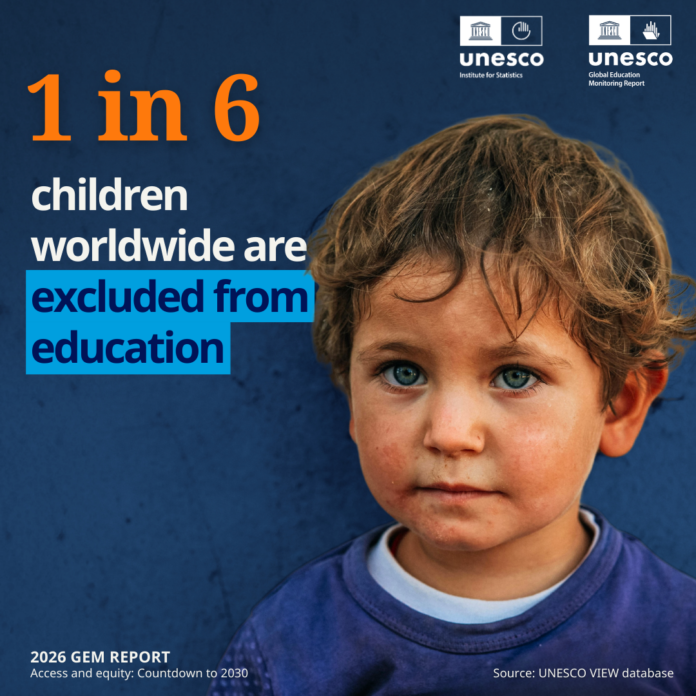
The number of children and youth out of school worldwide has climbed for the seventh straight year to 273 million, with sub‑Saharan Africa – including East African nations – accounting for the steepest increases driven by population growth, conflict and funding shortfalls, UNESCO’s 2026 Global Education Monitoring (GEM) Report warns.
One in six school‑age children globally is excluded from education, and only two in three complete secondary school, the report states. While primary and secondary enrolment has risen 30 per cent since 2000 (adding 1.4 billion students), progress has stalled since 2015, particularly in sub‑Saharan Africa where crises compound demographic pressures.
UNESCO Director‑General Khaled El‑Enany noted: “This report confirms an alarming trend… However, there is hope. Since 2000, enrolment has increased overall by 30 per cent, and many countries are making meaningful progress.”
East Africa exemplifies the regional challenge: Ethiopia’s primary enrolment soared from 18 per cent in 1974 to 84 per cent in 2024, but conflict, displacement and budget squeezes now threaten reversals. Over one in six children live in conflict‑affected areas, adding millions to out‑of‑school totals beyond official counts, with Middle East tensions and African hotspots like Sudan exacerbating the crisis.
Positive outliers exist: Madagascar and Togo slashed out‑of‑school rates by 80 per cent since 2000; Morocco and Viet Nam halved adolescent exclusion; and Côte d’Ivoire achieved across‑age‑group gains. Gender gaps have largely closed at primary/secondary levels – Nepal’s girls now match or exceed boys via sustained reforms.
Completion rates have improved – primary from 77 to 88 per cent, lower secondary 60 to 78 per cent, upper secondary 37 to 61 per cent since 2000 – but at current paces, 95 per cent upper secondary completion would take until 2105.
Inclusion is gaining traction: countries with inclusive education laws rose from 1 to 24 per cent since 2000; those mandating settings for disabled children from 17 to 29 per cent. Financing mechanisms targeting disadvantaged groups – transfers to subnational governments, schools, students – quadrupled, though only 8 per cent of countries optimize redistribution.
Yet affordability pitfalls persist: past fee waivers boosted access but hurt quality and dropouts, ignoring transport, meals (now in 84 per cent of countries) or after‑school costs. Donor retreats threaten unbudgeted programmes.
“No single policy can fix exclusion,” GEM Director Manos Antoninis said. “Policies should address local realities… National targets must be ambitious yet achievable.”
Evidence‑backed combos work: compulsory education plus child labour laws added a year of schooling in 14 African countries; electrification gained nearly a year in Cambodia; school feeding yields half a year’s learning per $100 spent; attendance‑tied cash transfers boost enrolment 36 per cent.