
At a time when Sudan is navigating complex internal political instability and conflict, it is actively looking outward to the global stage to secure long-term alliances, economic development initiatives, and strategic partnerships.
At the center of this diplomatic effort is Khartoum’s growing relationship with the Russian Federation, which has become prominently visible in preparations for high-level participation in the third Russia-Africa Summit this coming October.
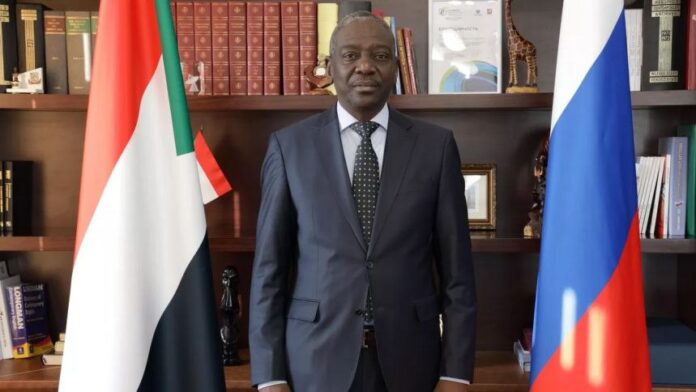
Mohammed Eltigani Siraj, Sudan’s Ambassador to the Russian Federation, recently underscored the critical importance of these bilateral ties while marking the 70th anniversary of diplomatic relations between the two countries.
Citing recent high-level dialogue forums, including those held at the 11th session of the Sudan-Russia Political Consultation Committee in Moscow, Sudanese officials confirmed that the Chairman of the Transitional Sovereignty Council, Abdel Fattah al-Burhan, will lead an official delegation to the October summit. This high-level participation is expected to yield major agreements in energy, trade, infrastructure development, food security, and military-technical cooperation.
Following the eighth and most recent intergovernmental committee meetings, bilateral relations have gained significant momentum. These cooperation frameworks have produced protocols encompassing critical projects designed to support Sudan’s upcoming reconstruction phase. Bolstered by an encouraging political atmosphere created by leaders in both capitals, Russian enterprises have increased their focus on investment opportunities within Sudan’s oil, mining, energy, and transport sectors.
Beyond economic and trade exchanges, academic and cultural cooperation have begun to play a major role. In recognition of strong bilateral ties, the Russian Government has increased scholarship opportunities for Sudanese students by 40%, with plans to admit 140 new students for the 2026–2027 academic year. As Ambassador Siraj noted, these educational exchanges build upon a historical foundation laid during the Soviet era, when thousands of African specialists, engineers, and professionals received training in Russia.