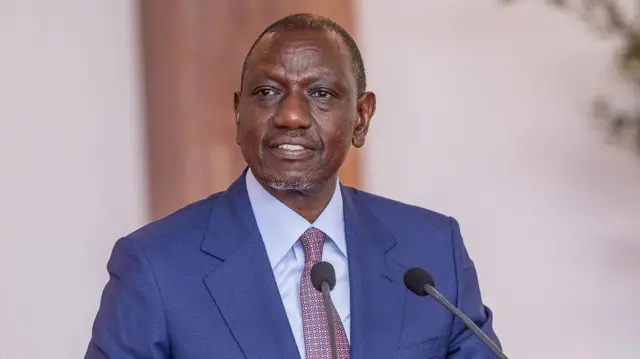
Kenyan President William Ruto has signed into law the establishment of the National Infrastructure Fund (NIF), a landmark measure that consolidates the country’s major transport and logistics agencies under a unified investment framework.
The legislation, approved on Monday, brings together the Kenya Ports Authority (KPA), Kenya Railways, and the Kenya Airports Authority (KAA) under the NIF’s umbrella. President Ruto said the fund will allow these state-owned enterprises to access capital markets using their assets, enabling them to raise financing for future expansion and maintenance projects.
“This marks a shift in how we finance infrastructure,” Ruto said during the signing ceremony. “We are moving from relying on external borrowing to leveraging our own domestic capacity and institutional assets.”
The NIF will begin operations with a seed capital of 106 billion shillings, generated through the partial privatization of the Kenya Pipeline Company (KPC). Over the next decade, the government aims to mobilize up to 5 trillion shillings through the fund.
According to the proclamation, the NIF will be governed by an independent board composed of experienced professionals, including experts from development finance institutions. Politicians are expressly barred from serving on the board, which will oversee the fund’s investment policies and ensure transparency. While participating agencies will continue managing their individual assets, they are prohibited from borrowing in the fund’s name.
Analysts say the restructuring is expected to strengthen Kenya’s regional transport competitiveness and enhance trade links across East Africa. By aligning ports, railways, and airports under a coordinated financial strategy, Kenya hopes to reduce logistical inefficiencies and attract greater private investment.
Government sources indicate that the NIF targets to raise nearly half its ten-year goal—about 2.5 trillion shillings—by April 2026 as the first phase of implementation accelerates.