
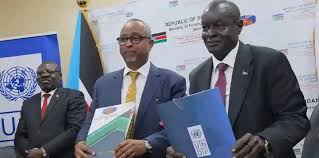
South Sudan has officially launched a $5 million Public Financial Management (PFM) reform project, significantly reducing its years-long dependence on international donor funding. This five-year initiative, signed in partnership with the United Nations Development Programme (UNDP), is viewed as a strategic step where the government takes full responsibility for financing and implementing institutional reforms.
The agreement, signed in Juba on Thursday, is being hailed by government officials and international partners as a “historical milestone.” Since gaining independence in 2011, South Sudan’s financial landscape has been characterized by fragile institutions and a budgeting process heavily reliant on external aid; however, this new program places the Ministry of Finance and Planning in a lead administrative role.
UNDP Resident Representative Mohamad Abchir described the agreement as a clear indicator of the country’s reform agenda, stating during the ceremony that it is a truly historical moment and a major achievement for South Sudan.
He emphasized that beyond being a financial pact, this initiative demonstrates the government’s commitment to improving public financial management and building a culture of internal accountability. Under the agreement, the Ministry of Finance and Planning will not only provide financial support for the project but will also oversee its execution. In terms of building indigenous capacity, the technical work is planned to be carried out by South Sudanese professionals working within government institutions rather than relying solely on foreign consultants.
A primary component of the reform is the cleanup of the public payroll. For years, South Sudan has been exposed to significant resource wastage due to “ghost workers”—individuals who are not active employees but remain on the payroll. Benjamin Ayali Koyongwa, Undersecretary of the Ministry of Planning, stated that the government plans to contribute approximately $1 million annually to the project.
This funding is largely expected to come from savings generated by registering civil service workers using a biometric fingerprint system. Ayali candidly noted that they currently do not know exactly how many people are being paid, making the biometric system essential to ensure public funds reach legitimate workers. He added that cleaning the payroll could provide substantial resources for actual salaries and essential public services.
Beyond payroll issues, the project aims to resolve long-standing weaknesses in budgeting and procurement systems.
These sectors have historically been vulnerable to waste and misappropriation of public funds, often causing development projects to stall before they even begin. This project was launched at a critical time as the reform support provided by Norway since 2020 is set to conclude in June. Addressing the question of what happens after donor funding ends, Ayali asserted that it is now vital for the government to step in and cover the remaining requirements. The project will be led by a steering committee and audited by the National Auditor General to ensure transparency.