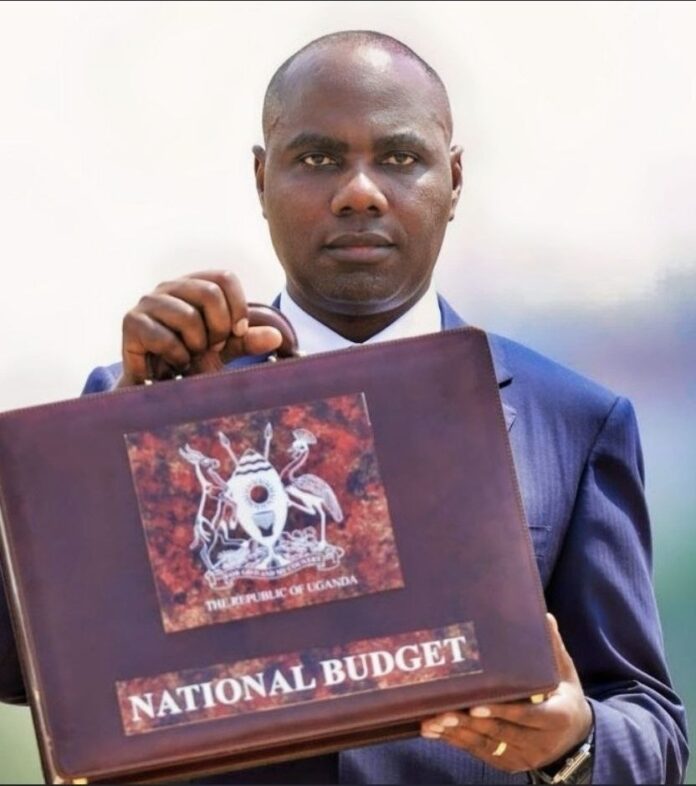
Finance Minister Henry Musasizi last week unveiled a massive National Budget Framework of Shs84.4 trillion for the 2026/2027 financial year. This new budget reflects the country’s strategic plan to accelerate economic transformation by leaning heavily on oil production, infrastructure development, agriculture, and industrial expansion. Alongside these key drivers, the government projects a robust economic growth rate of 10.2 percent for the upcoming fiscal year.
Presenting the budget on behalf of President Yoweri Museveni during a parliamentary sitting on Thursday, June 11, 2026, at the Kololo Independence Grounds, Minister Musasizi stated that the economy is on a firm path toward recovery and expansion. He attributed this positive momentum to improved macroeconomic stability and a steady rise in investment inflows. He noted that the economy is stable, growth is accelerating, inflation remains low, the exchange rate is steady, exports are rising, and investments are increasing, positioned for a major structural shift once commercial oil production officially begins.
The Shs84.4 trillion resource envelope comprises domestic revenues, borrowing, external financing, and debt refinancing flows. Domestic revenue is projected to reach Shs45.96 trillion, with Shs40.16 trillion coming from tax collections, Shs4.02 trillion from non-tax revenue, Shs1.44 trillion from petroleum revenue, and Shs339.8 billion from local government own-source revenue. Domestic borrowing is projected at Shs11.97 trillion, while external budget support and project financing will contribute Shs1.22 trillion and Shs11.27 trillion respectively. The framework also includes Shs13.97 trillion in domestic debt refinancing to roll over maturing obligations within the domestic debt market.
On the expenditure side, the government has allocated Shs9.71 trillion for wages and salaries, while non-wage recurrent expenditure stands at Shs33.28 trillion. This category covers the operational funding of government institutions, service delivery programmes, interest payments, health and education grants, essential medicines, infrastructure maintenance, and wealth creation initiatives. Meanwhile, development expenditure is projected at Shs22.05 trillion. The government strongly believes that financing its own development from domestic resources grants the nation greater policy independence, resilience, and sustainability.
Infrastructure remains a central pillar of the budget, with Shs8.79 trillion allocated to transport systems, including roads, bridges, railways, airports, and related logistics infrastructure. The minister confirmed that construction of the Standard Gauge Railway (SGR) from Malaba to Kampala is at an advanced stage and is expected to significantly reduce transport costs while improving regional competitiveness. Additionally, the government plans to expand Uganda Airlines by acquiring eight additional aircraft to strengthen tourism, trade, and international connectivity.
The oil and gas sector remains a primary driver of the projected economic expansion, with the ongoing development of the East African Crude Oil Pipeline (EACOP) and central processing facilities moving forward rapidly. Musasizi informed Parliament that drilling activity has already exceeded initial requirements for first oil, noting that 51 additional wells were drilled to bring the cumulative total to 199 wells, which surpasses the 189 wells required for the launch of production later this year.
Health and education continue to receive significant funding, with Shs5.23 trillion allocated to the health sector and Shs6.66 trillion to education. Within this allocation, Shs568.65 billion has been earmarked for salary enhancements for primary school teachers as well as arts teachers in secondary and technical institutions.
In agriculture and wealth creation, Shs2.26 trillion has been allocated to agro-industrialisation, while Shs2.49 trillion will support broader wealth creation programmes, including the Parish Development Model (PDM) and Emyooga, which are aimed at shifting rural households from subsistence to commercial production.
On the broader economic front, the minister highlighted that Uganda’s foreign exchange reserves have risen to US6 billion, with total exports of goods and services reaching US18.04 billion in the year ending March 2026, driven heavily by coffee exports which generated US2.46 billion. However, he acknowledged concerns over public debt levels, which stand at US34.86 billion (equivalent to Shs126.19 trillion or 53 percent of GDP), but maintained that the debt remains sustainable over the medium and long term. Finally, security institutions received Shs10.21 trillion to support defence modernization and community policing, with Musasizi concluding that without peace, security, and the rule of law, prosperity and growth cannot be sustained.