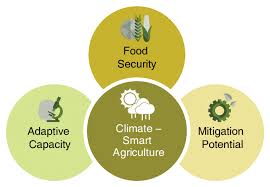
In a landmark gathering that signals a shift from policy dialogue to aggressive field-level implementation, ministers and regional heads from Eastern and Southern Africa have committed to a unified roadmap to scale Climate-Smart Agriculture (CSA) across the continent. The high-level political and technical dialogue, held in the Ethiopian capital Addis Ababa.
The event, jointly organized by the World Bank, the Intergovernmental Authority on Development (IGAD), and the Centre for Coordination of Agricultural Research and Development for Southern Africa (CCARDESA), brought together a coalition of policy makers, private sector actors, and research institutions to tackle the structural threat climate change poses to African agrifood systems.
The delegates formally recognized that CSA is no longer an optional “parallel climate agenda” but the essential delivery pathway for achieving productivity, food security, and inclusive livelihoods. This realization comes as the region faces a rising tide of environmental crises, including flash floods, extreme heat, land degradation, and transboundary pests.
“We recognize the need to move from commitment to coordinated implementation and investment mobilization,” the delegation noted, emphasizing that the scale of current climate shocks requires responses that transcend national borders.
The communiqué put forward several high-priority recommendations designed to revolutionize how agriculture is funded and practiced in Africa. Leaders urged for CSA to be embedded directly into national budget frameworks and public expenditure reviews to move from strategy formulation to prioritized, investment-ready pipelines that meet the requirements of private investors and climate funds.
Scaling CSA also requires systemic reform that links research directly to farmer adoption, including modernizing extension services and expanding digital agro-advisory platforms to ensure that climate-smart technologies reach the smallholder level rapidly.
Regional bodies like IGAD and CCARDESA are being called upon to evolve into “scale accelerators” that focus on joint programming, harmonizing metrics, and providing decision-ready evidence to support the “evidence-to-finance” chain.
The roadmap also prioritizes regional investments in digital public goods, such as early warning systems, soil health hubs, and harmonized seed regulations. Furthermore, by leveraging regional trade opportunities under the African Continental Free Trade Area (AfCFTA), leaders aim to expand markets for climate-smart agricultural products, creating a value chain that incentivizes resilient production.
To fund this transformation, the communiqué calls for a departure from short-term project cycles toward predictable, multi-year support from development partners. This includes the use of blended finance—combining public resources with private capital and insurance—to de-risk investments in CSA value chains. There is also a push to repurpose existing agricultural expenditures toward resilience-enhancing tools like irrigation efficiency and sustainable fertilizer use.
To ensure the momentum generated in Addis Ababa translates into results, the participants proposed the development of a CSA Action Note and Roadmap. This document will be developed by regional institutions in collaboration with the World Bank to define specific workstreams, institutional responsibilities, and implementation milestones.