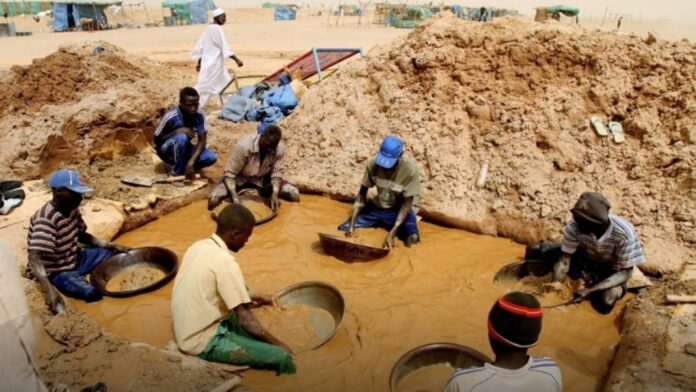
An unprecedented expansion of informal and artisanal gold mining in northern Sudan’s River Nile and Northern states has unleashed a devastating environmental and public health crisis. Driven from their homes by nationwide conflict, hundreds of thousands of internally displaced persons (IDPs) have turned to hazardous chemical extraction methods to survive, fueling a toxic gold rush across relatively peaceful northern regions.
With the ongoing war crippling agriculture, industrial manufacturing, and international trade, gold prospecting has emerged as one of the few viable economic lifelines remaining in Sudan. Data from the Ministry of Minerals and the state-run Sudanese Mineral Resources Company indicate that the informal artisanal sector now forms the backbone of the country’s precious metals production. Generating over 80% of Sudan’s total gold output and contributing more than $1.5 billion annually to the national economy, artisanal mining accounts for over 58% of national exports. An estimated two to five million people are now directly or indirectly involved in this sprawling, informal mining economy.
However, the economic refuge provided by artisanal mining comes at an astronomical environmental cost. Millions of tonnes of toxic tailings—locally referred to as “karta”—have accumulated near residential neighborhoods, fertile agricultural date palm groves, and crucial freshwater arteries across the River Nile and Northern states.
Processing hubs and illicit extraction sites are expanding rapidly around major trading areas like El-Obeidiya, Abu Hamad, and adjacent seasonal dry valleys (wadis). Miners frequently construct open extraction basins treated with mercury and cyanide just yards away from shallow groundwater sources and farmland. During seasonal rains, toxic runoff from these unlined chemical ponds washes into nearby irrigation canals and soil beds, causing widespread livestock poisoning and contaminating local drinking water supplies.
Field research and laboratory testing conducted by Sudan Tribune highlighted the dangerous scale of the chemical exposure. Laboratory analysis of soil and water samples collected from “Village 3” in River Nile state revealed extreme mercury contamination. Soil tests registered concentration levels as high as 2,825.24 units at neutral pH, with readings deep below the surface consistently exceeding 866 to 1,055 units—surpassing safety thresholds set by the World Health Organization (WHO) and the U.S. Environmental Protection Agency (EPA).
Water sources relied upon by local communities, including traditional clay cooling pots (zeers), livestock watering troughs, and the main Keheila irrigation canal, exhibited significant contamination risks. Previous academic investigations led by researchers from Neelain University and the Sudanese Environment Conservation Society found that nearly 20% of sampled drinking water supplies north of Atbara and south of Berber contained measurable traces of mercury and cyanide. Biological testing further confirmed positive mercury absorption among local residents, including children as young as four to 11 years old.
For the miners, economic survival outweighs the known biohazards. Displaced workers acknowledge using cyanide basins and mercury mixers without protective gear, citing a lack of alternative livelihoods in war-torn Sudan. Meanwhile, local business owners and health workers report a sharp rise in dermatological conditions, acute skin lesions, and unexplained chronic respiratory illnesses among miners and residents living downwind from processing yards.
Local farm owners report that illicit operators function around the clock, dumping tons of hazardous materials without oversight. Officials at the Sudanese Mineral Resources Company acknowledged that while state regulations strictly prohibit the open use of mercury and cyanide outside specialized industrial facilities, wartime governance disruptions and mass displacement have enabled illicit chemical markets to operate far beyond state control. Although joint security inspections aim to dismantle unauthorized sites, the sheer scale of the unregulated boom continues to threaten northern Sudan’s water security, agriculture, and public health.