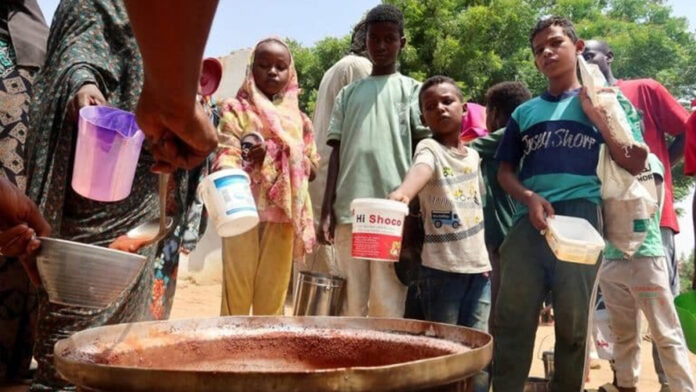
An alarming convergence of relentless conflict, widespread civilian displacement, and severe El Niño-induced drought is rapidly accelerating the risk of famine across Sudan’s Greater Darfur and Greater Kordofan regions. According to a critical emergency alert issued by the Integrated Food Security Phase Classification (IPC)—a United Nations-backed multi-partner initiative that integrates governments, UN agencies, non-governmental organizations, and civil society groups—vital food reserves across the country are rapidly depleting as an unprecedented agricultural failure spreads across more than half of Sudan, leaving millions of vulnerable people on the verge of starvation.
The humanitarian situation has deteriorated drastically as nationwide displacement has surged to an estimated 8.58 million people. The crisis is further exacerbated by extreme water deficits and failed seasonal rainfall, which have left approximately 50 percent of Sudan’s croplands exhibiting severe vegetation deficits. The environmental strain is particularly acute in North Darfur, where 64 percent of cultivated areas suffer from poor biomass. Extensive field surveys conducted between August and September in Eastern Jebel Marra, South Darfur, revealed that global acute malnutrition (GAM) rates hit catastrophic levels of 38 percent and 30.8 percent in two key displacement camps—far exceeding the 30 percent threshold required for a formal famine classification.
Child malnutrition rates are rising sharply throughout the Darfur region. Healthcare centers in Nyala reported that the proportion of children admitted for severe acute malnutrition doubled between January and August, while in Kas locality, child admissions quadrupled between January and June.
Simultaneously, Greater Kordofan has rapidly developed into a central hub of active military hostilities, displacing over 300,000 people since late 2025. Fierce fighting across North Kordofan has driven entire farming communities off their agricultural lands and forced them into the regional center of El Obeid. In South Kordofan, active clashes in the Heiban locality and Kauda have pushed thousands of civilians into isolated mountain areas precisely during the critical planting season, severely undermining local food production. Meanwhile, West Kordofan is battling one of its most severe droughts since 2004 alongside a worsening cholera outbreak, compounding an already dire public health catastrophe.
Humanitarian relief operations face severe operational constraints due to deliberate access blockages, widespread insecurity, and crippling funding deficits. Aid workers are operating in increasingly dangerous conditions; in early October, two World Food Programme-contracted humanitarian convoys came under direct fire, resulting in the tragic death of a driver. Compounding these physical hazards, the financial shortfall remains stark. As of October 8, the 2026 Humanitarian Needs and Response Plan for Sudan faces a 57 percent overall funding gap. Crucial emergency sectors are suffering most acutely, with nutrition receiving only 30 percent and water, sanitation, and hygiene (WASH) receiving a meager 23 percent of required funding.
In light of these findings, the IPC’s Famine Review Committee cautioned that repeated conflict impacts and dry-season pressures are systematically collapsing the essential infrastructure and support systems vital to civilian survival. The international coalition is urging immediate, unhindered humanitarian access across all territories, complete funding of the emergency response plan, and sustained international diplomatic pressure to cease targeted attacks against civilians and critical infrastructure before the famine expands further.