
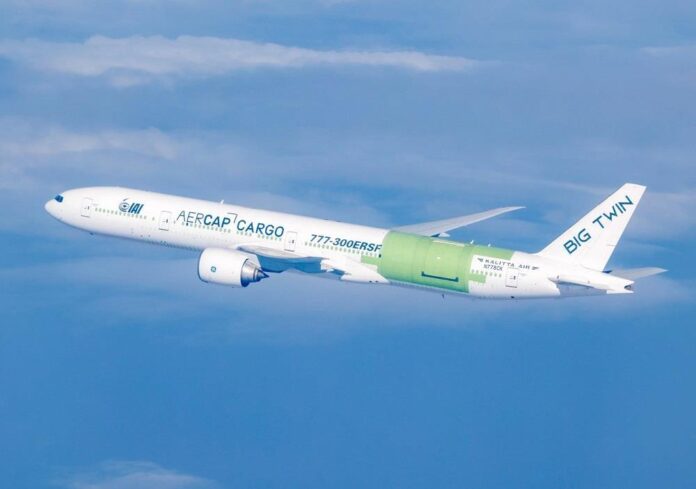
Ethiopian Airlines Group has taken a decisive step to further solidify its undisputed leadership in the African aviation sector. The airline officially signed a lease agreement for two Boeing “777-300ERSF” aircraft, which are being converted from passenger to freighter configuration.
This agreement, partnered with AerCap, the world’s largest aircraft lessor, and Israel Aerospace Industries (IAI), a pioneer in aviation technology, marks the first time this modern aircraft model will operate on the African continent.
According to information obtained from FlightGlobal, these massive cargo planes, nicknamed the “Big Twin,” are scheduled for delivery to the airline’s main hub in Addis Ababa starting in the second quarter of 2028.
This acquisition serves as a cornerstone of the airline’s “Vision 2035” strategy, which aims to transform Ethiopia into a globally competitive multimodal logistics hub.
The Boeing “777-300ERSF” is not merely a standard cargo plane but a game-changer for the logistics industry. Developed through a collaboration between IAI and AerCap, this aircraft represents the first passenger-to-freighter (P2F) conversion of the 777-300ER platform.
The “Big Twin” offers unique advantages, including a massive loading capacity that provides 25% more cargo volume than the standard 777-200F and a payload capacity of up to 100 tonnes.
Furthermore, the aircraft is highly fuel-efficient. Powered by twin GE90-115B engines, it consumes approximately 21% less fuel per tonne compared to the aging four-engine Boeing 747-400 freighters it is intended to replace.
This reduction in fuel consumption directly leads to lower carbon emissions, aligning with Ethiopian Airlines’ commitment to building a sustainable and green aviation industry.
Ethiopian Airlines Group CEO, Mesfin Tasew, stated that these aircraft will significantly enhance the carrier’s cargo capacity and efficiency, thereby boosting trade within the region and beyond. He noted that the partnership with AerCap and IAI allows the airline to integrate the latest technologies into its operations while maintaining high standards in maintenance and training programs.
The relationship between Ethiopian Airlines and IAI is deep-rooted, dating back five years when the two organizations established a freighter conversion center at the airline’s MRO facility in Addis Ababa. While that facility initially focused on Boeing 767-300ER conversions, the addition of the 777-300ERSF represents a significant leap in the airline’s technological capabilities.
AerCap CEO Aengus Kelly added that the 777-300ERSF is the “ideal aircraft” for an airline of Ethiopian’s scale, noting its cost-efficiency and long-range capabilities will help reach high-demand markets in Asia, Europe, and the Americas profitably.
The timing of this acquisition is pivotal as Ethiopian Cargo & Logistics Services continues to expand rapidly, recently adding Casablanca as its 35th freighter destination in Africa. As the African Continental Free Trade Area (AfCFTA) gains momentum, the demand for high-capacity, long-haul cargo transport is skyrocketing.
The new 777-300ERSF will complement the existing fleet of 777F and 737-800SF freighters. Additionally, the airline holds a provisional agreement for five next-generation Boeing 777-8 freighters, ensuring its fleet remains the youngest and most modern in the region through the 2030s.
The entry of the 777-300ERSF into Africa facilitates more than just moving boxes; it enables the efficient transport of high-value goods, e-commerce, and perishables. This will further strengthen Ethiopia’s dominant market share in flower and coffee exports.
Coupled with the ongoing construction of the Bishoftu International Mega Airport—set to be Africa’s largest gateway—these aircraft will serve as the primary workhorses for a truly global network. When the first 777-300ERSF touches down in Addis Ababa in 2028, it will be a powerful symbol of Africa’s rising influence in the global supply chain.