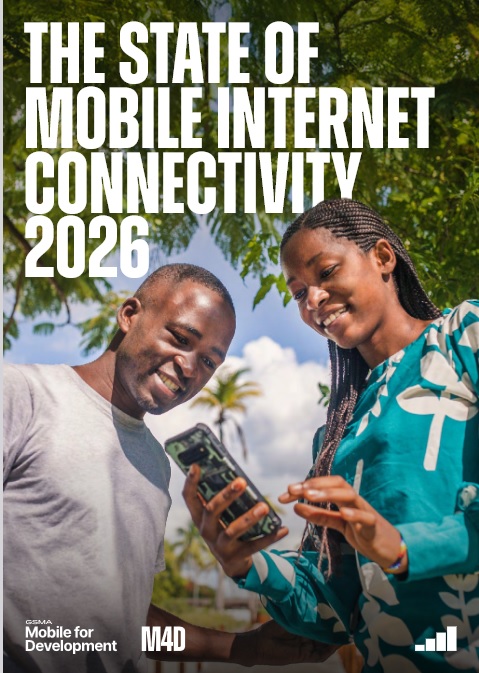
While global mobile broadband networks continue to expand, Sub-Saharan Africa remains the world’s least-connected region, with only 25 percent of its population using mobile internet on their own devices, according to a report released by the GSMA.
The annual study, titled “The State of Mobile Internet Connectivity 2026,” reveals that the primary challenge across the continent is no longer a lack of network infrastructure, but rather a substantial “usage gap.” Approximately 66 percent of Sub-Saharan Africa’s population—amounting to 820 million people—lives within the footprint of a mobile broadband network but does not use mobile internet services. The region also contends with the world’s largest remaining network coverage gap, with 9 percent of the population (110 million people) entirely lacking mobile broadband access.
The report identifies device affordability as the single most critical obstacle preventing non-users from coming online across African markets. Across low- and middle-income countries, the retail price of an entry-level, internet-enabled handset accounts for 44 percent of average monthly income for the poorest 20 percent of the population, soaring to 76 percent of monthly income for the poorest quintile in Sub-Saharan Africa.
This affordability barrier faces fresh headwinds from global supply chain pressures. Surging demand for high-performance memory chips in artificial intelligence systems and data centers has driven steep price increases for semiconductor components, pushing up the bill of materials for smartphone manufacturers.
As component costs rise, global shipments of smartphones priced under $100 are projected to drop by 36 percent in 2026. Sub-Saharan Africa is anticipated to see 16 million fewer smartphone shipments this year—a decline of more than a quarter compared to 2025—threatening recent industry initiatives aimed at deploying affordable 4G handsets across the continent.
The digital divide within Africa is further compounded by demographic and geographic disparities. Across low- and middle-income countries, women represent 58 percent of the adult usage gap, while rural residents are 28 percent less likely to adopt mobile internet than urban populations.
Survey findings from African nations, including Ethiopia, Ghana, Kenya, Nigeria, Senegal, and Uganda, indicate that the most severe drop-off in the digital adoption journey occurs between awareness and handset ownership, especially among rural women. Once individuals acquire an internet-enabled device, adoption follows rapidly.
For existing users, data affordability and network quality present ongoing hurdles. The median cost of 20 gigabytes of mobile data represents 14 percent of average monthly income in Sub-Saharan Africa—nearly five times the global median—and rises to 44 percent of monthly income for the poorest 20 percent.
GSMA analysis estimates that closing the global mobile internet usage gap would generate $3.5 trillion in additional gross domestic product between 2023 and 2030, with developing economies capturing more than 90 percent of the economic dividend.
To prevent expanding digital exclusion, the report urges African governments, telecommunications operators, and international development partners to implement targeted interventions.
Key policy recommendations include reducing customs duties and sector-specific taxes on entry-level smartphones, scaling accessible micro-financing mechanisms for devices, expanding digital literacy training, and curating local-language digital content to ensure underserved populations can participate fully in the digital economy.