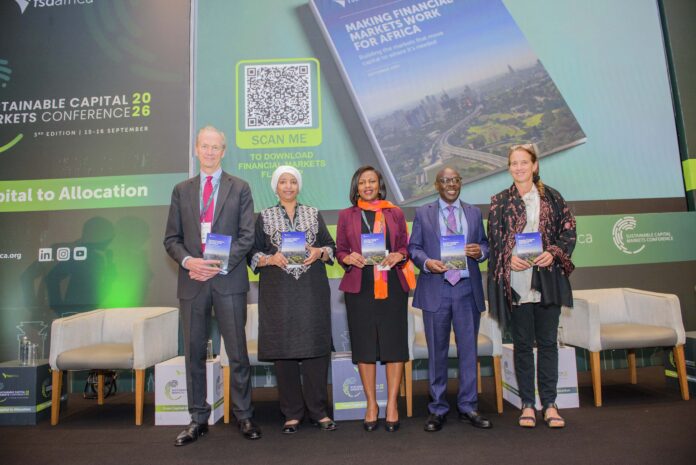
More than 300 policymakers, central bankers, institutional investors, and capital market regulators from over 20 African nations have gathered in Nairobi for the third Sustainable Capital Markets Conference, organized by FSD Africa and regional partners.
The high-level meeting takes place at a critical juncture for African economies, as governments confront tightening global financial conditions, reduced overseas development funding, slowing foreign direct investment, and elevated debt-servicing burdens. In response, delegates are focusing on accelerating domestic resource mobilization to bridge the continent’s widening development and climate financing gaps.
Although African domestic equity markets have expanded 27-fold since 2000 to reach $561 billion, the continent’s share of global capital market activity has declined relative to international benchmarks. Debt capital markets remain particularly shallow, with fewer than half of African countries seeing a domestic corporate bond issuance since 2000.
In contrast, domestic institutional investors—including pension funds, life insurance companies, commercial banks, and sovereign wealth funds—now manage an estimated $4 trillion in assets. However, only 2.7 percent of these institutional funds are currently invested in infrastructure, energy transition, or other productive real-economy sectors.
Discussions at the conference are centered on restructuring domestic financial ecosystems to direct long-term institutional savings into vital economic sectors that support job creation for the roughly 25 million young people entering the African workforce annually.
The summit convenes leading voices across sustainable finance, sovereign debt management, and investment mobilization, including Mark Napier, CEO of FSD Africa; Yodit Kassa, CEO of the Ethiopia Stock Exchange; Nicholas Kebaso, CEO of the Lusaka Stock Exchange; Jonathan Stichbury, CEO of SanlamAllianz Investments; Chris Olobo, CEO of Dhamana Guarantee; Albert Rweyemamu of ATIDI; Daniel Mainda, CEO of the Nairobi International Financial Centre Authority; and senior finance ministry officials from across the region.
Sessions focus on strengthening market infrastructure and regulatory frameworks, establishing benchmark yield curves, and developing credit enhancement tools. Delegates are also exploring mechanisms to scale up green, social, gender, and transition bonds to finance clean energy and climate resilience projects.
Additional discussions center on structuring blended finance and public-private partnerships that de-risk projects for private capital, improving sovereign debt transparency, and creating investable pipelines of infrastructure assets suited to long-term institutional mandates.
To translate strategic dialogue into tangible market outcomes, the conference is structured around three core deliverables.
Delegates will first finalize the Africa Capital Markets Roadmap, establishing a shared continental agenda to accelerate the development of deeper, more efficient, and interconnected capital markets.
The gathering will also adopt a capital mobilization framework setting out coordinated actions on regulatory harmonization, priority financing structures, and innovative investment vehicles.
Finally, the conference aims to establish practical investment pathways to unlock Africa’s $4 trillion institutional capital pool, directing funding toward climate-resilient infrastructure, small and medium enterprise development, and regional value chains.