The Bill & Melinda Gates Foundation has announced a commitment to invest at least $1 billion over the next two years to ensure artificial intelligence technologies reach frontline communities in developing nations, with a major focus on Africa’s healthcare, agricultural, and educational systems.
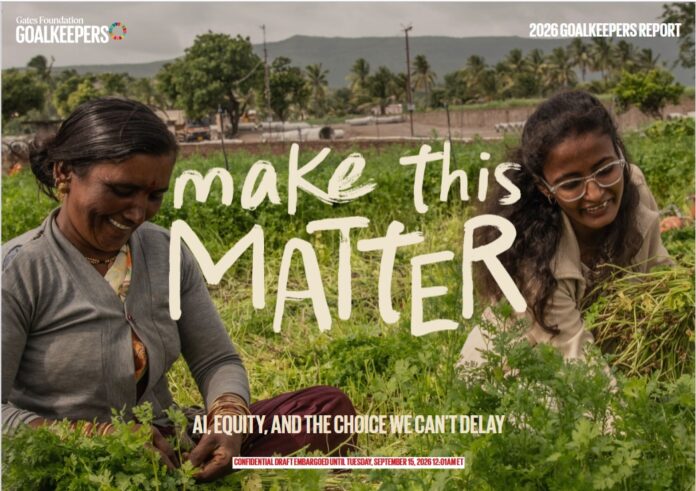
The funding coincides with the release of the foundation’s 10th annual Goalkeepers Report, titled “Make This Matter: AI, Equity, and the Choice We Can’t Delay,” which warns that market forces alone will concentrate advanced AI tools among the wealthiest institutions unless deliberate interventions are made to serve lower-income populations.
In the report, foundation chair Bill Gates emphasized that the rapid evolution of AI threatens to replicate historical technology divides at an accelerated pace if tools are not designed specifically for the places where they are needed most.
Gates noted that the foundation was created in part to address a fundamental market failure where people with the greatest needs often have the least power to shape investment. He warned that without targeted public and philanthropic intervention, the most capable AI tools will be built primarily for institutions able to pay for them, rather than communities that could benefit the most.
A central hurdle for African and developing nations is linguistic and contextual exclusion. More than 90 percent of the training data used for early large language models originated from English-language sources, leaving African languages, local farming practices, and community healthcare environments severely underrepresented.
To counter this disparity, the Goalkeepers Report outlines three immediate priorities: building AI tools in every language people speak, developing models rooted in local community data and governance, and investing directly in doctors, teachers, farmers, and local developers so they can adapt the technology to their specific realities.
The $1 billion commitment will be deployed across four primary priority sectors over the next two years to accelerate practical, ground-level adoption.
Forty percent of the funds will support healthcare initiatives, focusing on diagnostic aids and clinical decision-support systems for frontline health workers, maternal and newborn care tools, and the discovery of new drugs and vaccines. Another 40 percent is allocated to education, supporting AI-driven tutoring platforms to personalize student learning and providing assistive teaching tools in classrooms.
Ten percent of the funding is directed toward agriculture to equip smallholder farmers with customized AI advisory tools tailored to local soil, crop, and weather conditions. The remaining 10 percent will build foundational digital infrastructure, specifically curating representative datasets in underrepresented regional languages to enable AI systems to communicate accurately in local idioms.
The foundation stressed that AI has the potential to act as a powerful equalizer across the Global South, putting expert-level medical guidance, personalized teaching, and agronomic advice directly into the hands of hundreds of millions of people who missed out on previous technological revolutions.
Calling on governments, technology enterprises, and philanthropic partners to align their investments with public-interest goals, Gates reiterated that equitable technology delivery will not happen by chance. Success, the report concludes, must be judged not merely by commercial profit, but by how effectively AI improves the lives and livelihoods of the world’s most vulnerable populations.