The European Investment Bank (EIB), through its development arm EIB Global, has announced a grant of up to €4 million to the World Food Programme (WFP). The funding is dedicated to launching Ethiopia’s first-ever climate-risk insurance project, designed to safeguard vulnerable smallholder farmers against devastating weather shocks.
The official announcement was made during the ongoing United Nations Convention to Combat Desertification (UNCCD) COP17 conference in Mongolia, gathering international leaders to tackle desertification, land degradation, and escalating climate resilience challenges.
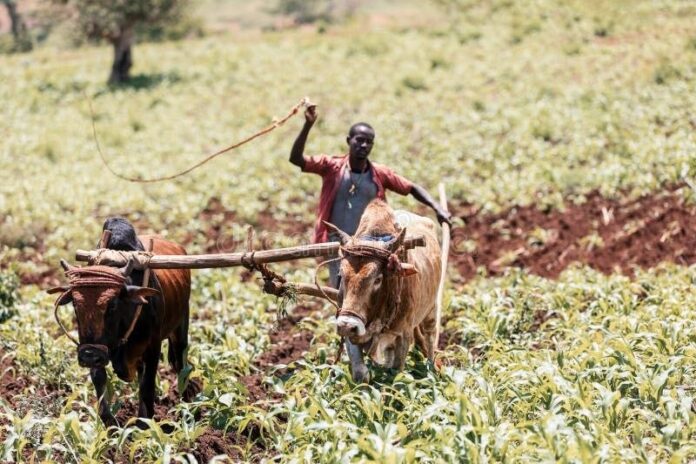
By weaving together credit lines, microinsurance, and institutional capacity building, the comprehensive financial package addresses the structural vulnerabilities of Ethiopia’s agricultural sector. Agriculture remains the backbone of the national economy, accounting for 32% of GDP, employing 64% of the workforce, and generating 79% of exports. Despite its economic weight, the sector relies heavily on rain-fed practices, leaving it acutely vulnerable to environmental shifts. Currently, agricultural insurance penetration in Ethiopia stands below 0.4%, starkly trailing regional and global averages..
To bridge this gap, the newly announced initiative will roll out tailored index-based microinsurance products. By utilizing objective metrics like rainfall levels rather than complex ground-level assessments, the project ensures rapid payouts. The scheme aims to directly protect approximately 210,000 smallholder farmers, securing their crops, livestock, and hard-earned livelihoods.
This €4 million grant functions as a direct complement to EIB Global’s pre-existing €110 million credit line earmarked for the third phase of the Rural Financial Intermediation Programme (RUFIP III). Distributed via the Development Bank of Ethiopia and local financial networks—including microfinance institutions and Rural Savings and Credit Cooperatives (RUSACCOs)—the package merges credit, insurance, and institutional capacity building.
To ensure long-term stability and overcome liquidity hurdles for rural borrowers, a specialized Premium Guarantee Fund is being established. Initially administered by the WFP, management of the fund will eventually transition to the Development Bank of Ethiopia. Furthermore, the RUFIP III framework embeds strong inclusivity targets, dedicating 50% of its financing to female beneficiaries and 20% explicitly toward climate adaptation projects.
Highlighting the importance of the partnership, EIB Vice President Gelsomina Vigliotti stated ”Climate change remains one of the greatest risks to agricultural livelihoods in Ethiopia. By combining insurance, credit, and capacity building, this initiative will strengthen resilience, support food security, and create sustainable economic opportunities for rural communities.”
Zlatan Milišić, WFP Representative and Country Director in Ethiopia, echoed these sentiments ”This partnership with EIB Global brings together climate risk insurance, rural finance, and capacity strengthening to help farmers invest with greater confidence, protect their livelihoods when shocks occur, and recover more quickly. It is an important step toward building more inclusive and climate-resilient financial systems in Ethiopia.”