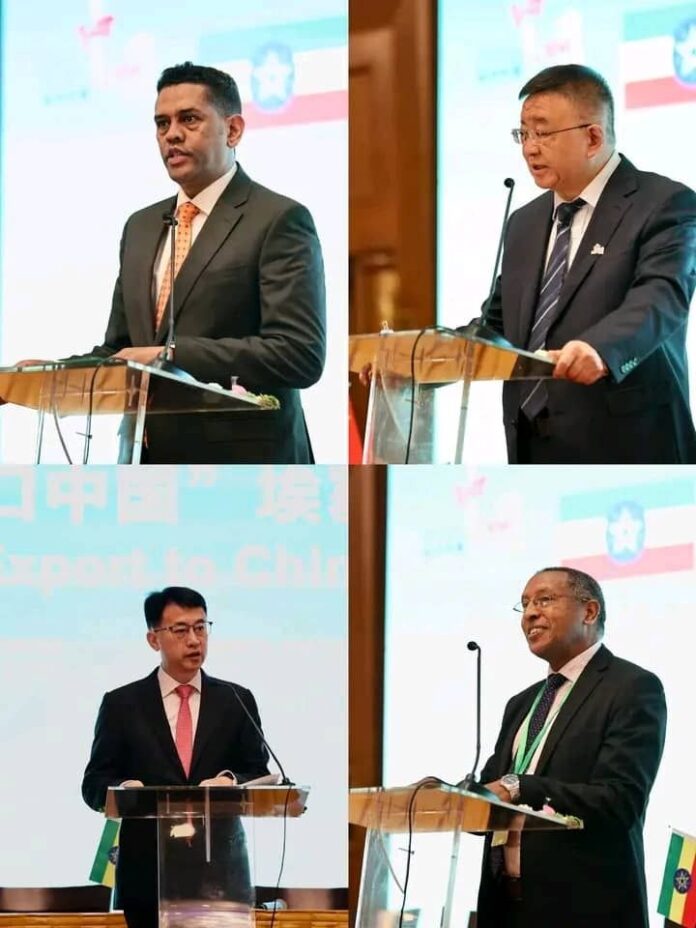
The growing Export-Import (EXIM) trade between Ethiopia and China stands as both a vital driver and a clear reflection of the two nations’ evolving economic ties. Minister of Trade and Regional Integration, Kassahun Gofe, affirmed this dynamic while addressing an event held in the capital under the theme “Big Market for All: Export to China” Ethiopia session.
Kassahun characterized the relationship between the two nations as an “unshakable alliance forged through mutual trust, respect, and a shared vision.” Over the past decades, this partnership has been elevated to an all-weather strategic level, yielding transformative infrastructure projects across the East African nation.
”China’s investment, technology, and industrial vision have played a foundational role in building Ethiopia’s modern economic landscape,” Kassahun stated, pointing to high-speed expressways, clean energy grids, world-class industrial parks, and the iconic Addis Ababa-Djibouti railway as testaments to successful bilateral cooperation.
A focal point of the minister’s address was China’s recent trade policy initiatives, particularly zero-tariff market access provisions for African exports. These measures have created unprecedented pathways for Ethiopian businesses to penetrate the world’s most dynamic market of 1.4 billion consumers.
”By opening the vast Chinese market wider to Ethiopian goods, you are not only satisfying the growing demand of Chinese consumers for premium products, but you are also creating resilient, balanced, and mutually beneficial trade architecture,” Kassahun noted.
Recent statistical data underscore this expanding engagement. In the 2025/26 fiscal year, Ethiopia’s exports to China climbed to 369 million USD, reflecting steady average annual growth over the past five years. However, imports from China remained significantly higher, standing at nearly 21 billion USD and growing at an average annual rate of 13 percent.
While the high volume of trade points to vibrant economic activity, the stark trade imbalance was acknowledged as a key area requiring strategic intervention. Minister Kassahun emphasized the urgent need to boost Ethiopia’s domestic export competitiveness and diversify its export portfolio to achieve a more sustainable trade balance.
To address these economic hurdles and foster broader growth, Ethiopia is pressing forward with comprehensive structural overhauls. Under the framework of the Homegrown Economic Reform agenda, the government has embarked on liberalizing key commercial sectors, modernizing the financial system, streamlining export procedures, and upgrading overall production quality.
These sweeping measures have already yielded notable dividends. Minister Kassahun reported that national exports crossed a major milestone, exceeding 11.2 billion USD in the 2025/26 fiscal year. Furthermore, ongoing efforts include liberalizing the foreign exchange market and modernizing trade logistics to make commercial operations more efficient and globally competitive.
Parallel to domestic reforms, Ethiopia’s long-term integration into the global trading system is accelerating. Kassahun highlighted that the country’s accession to the World Trade Organization (WTO) is advancing with strong momentum. He expressed deep gratitude for Beijing’s steadfast backing throughout the process, particularly regarding the successful conclusion of bilateral market access negotiations.
”As we enter the final stretch of this journey, we humbly request China’s continued, unreserved support until Ethiopia takes its rightful place as a full member of the WTO,” Kassahun concluded, signaling a hopeful outlook for future cooperation between the two strategic partners.