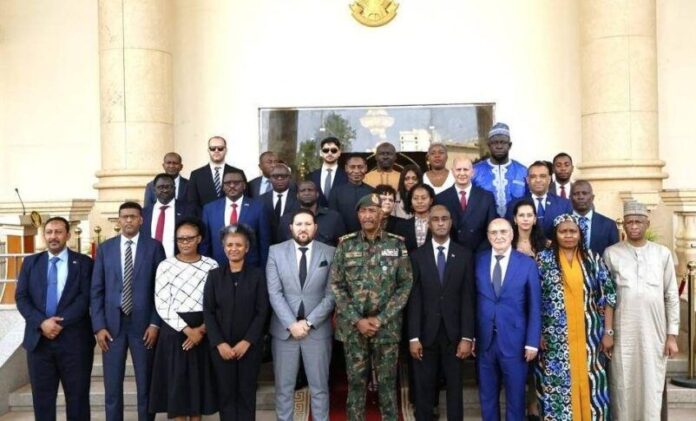
An African Union delegation arrived in Khartoum on Sunday for high-stakes meetings with top Sudanese officials, marking the bloc’s first official visit to the country since its membership was suspended following the October 2021 military coup.
The delegation, representing the AU Peace and Security Council (PSC) and led by Algerian Ambassador Mohamed Khaled, held constructive discussions with Sovereign Council leader Abdel Fattah al-Burhan and Prime Minister Kamil Idris. Ambassador Khaled described the talks as fruitful, reassuring Sudanese leadership of the bloc’s unwavering commitment to the nation’s sovereignty, territorial integrity, and national unity.
Foreign Minister Mohieddin Salem hailed the visit as historic, noting that it reflects the capital’s improving security landscape following the Sudanese Armed Forces’ recent success in recapturing vast portions of Khartoum. The mission builds upon prior diplomatic groundwork, including an October 2024 PSC field mission to Cairo and Port Sudan.
Yet, this diplomatic push unfolds against a volatile military background. While government forces have tightened their grip on Khartoum, the paramilitary Rapid Support Forces (RSF) retain significant control across the Darfur region. Meanwhile, Kordofan has transformed into a ferocious battleground. With neither side able to secure a knockout blow, the path to peace remains heavily obstructed.
During the discussions, Prime Minister Idris drew a hard line against the paramilitary group. He firmly rejected any political equivalence between the national army and the RSF, urging the African Union to back Khartoum’s ongoing campaign to officially designate the RSF as a terrorist organization—a stance Sudan has pushed globally since December 2025.
“Red lines cannot be crossed,” Idris stated, asserting that the country’s domestic affairs remain the exclusive domain of the Sudanese people. He also maintained that military operations would continue advancing through Greater Kordofan and onward to Darfur until full state control is reestablished.
The AU’s intervention highlights the desperate need to jump-start a stagnant political process. Previous efforts, such as the May 2023 Jeddah agreements, have collapsed repeatedly. Currently, the AU operates within a five-member diplomatic framework alongside the United Nations, European Union, IGAD, and the Arab League to bridge deep-seated divisions over peace frameworks.
The urgency of these efforts is underscored by a catastrophic humanitarian reality. The three-year conflict has claimed tens of thousands of lives and uprooted roughly 14 million people, triggering what the United Nations labels the world’s most severe displacement and hunger emergency. Nearly 19.5 million citizens face acute food insecurity, with over 800,000 young children battling severe malnutrition, while half of Sudan’s schools lie ruined, locking 8 million children out of education.
Despite these grim figures, the AU’s leverage remains constrained. Both warring factions continue to gamble on military victory, muting any appetite for compromise. Furthermore, international mediation remains fractured, complicated by outside actors accused by the UN of funneling advanced weaponry into the theater.
Despite these formidable hurdles, Ambassador Khaled emphasized the necessity of inclusive political dialogue and national reconciliation, firmly opposing the establishment of parallel authorities and advocating for future free and fair elections.
Adding momentum to domestic initiatives, General al-Burhan granted security guarantees and prosecution immunity late last week for participants of an upcoming internal national dialogue. Prime Minister Idris confirmed that this homegrown dialogue process would commence shortly to lay the groundwork for comprehensive national reconciliation.
Whether the renewed AU outreach can finally pierce the deadlock remains to be seen. As analysts observe, the primary obstacle has never been a lack of diplomatic blueprints, but rather convincing entrenched combatants to lay down arms when they still believe victory is possible on the battlefield.