Eritrea has formally called for the establishment of a regional security architecture in the Red Sea and Gulf of Aden that prioritizes the sovereignty of littoral states, strengthens indigenous defense and naval capabilities, and strictly limits the role of external powers.
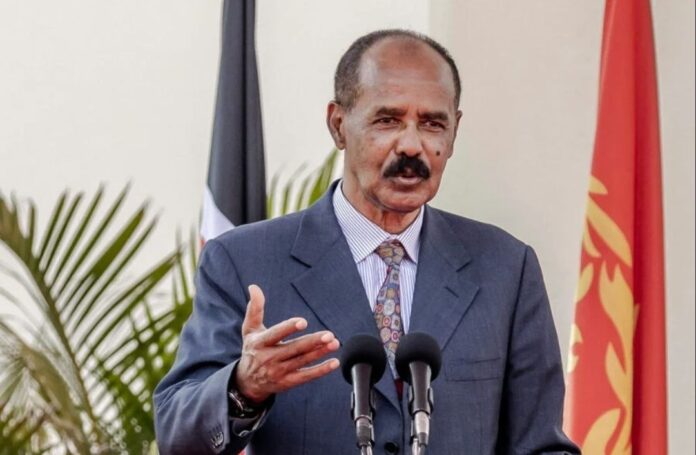
Eritrea Minister of Information Yemane Gebremeskel emphasized that building a synergetic and complementary collective security framework has become a critical necessity amid mounting geopolitical turbulence. He noted that Eritrea’s strategic approach centers on the core principles of national ownership, agency, and avoiding the pitfalls of a polarized climate driven by global rivalries.
Central to Eritrea’s proposal is a 12-point framework previously submitted to the Council of Red Sea and Gulf of Aden Littoral States. The framework urges all regional governments to conduct thorough assessments of security realities, clearly define regional objectives, categorize threats, and craft collaborative strategies to tackle them head-on.
Crucially, the document places strong emphasis on self-reliance in defense. Eritrea maintains that all littoral states must build and sustain independent defense capabilities and robust naval forces rather than delegating maritime security to external actors. Under the proposed arrangement, external involvement would only be permitted for complex tasks exceeding the collective capacity of regional nations, and such cooperation must strictly operate through a consensual framework. Furthermore, the architecture demands absolute respect for national sovereignty and international law, backed by dedicated committees to execute the proposed security modalities.
Minister Gebremeskel clarified that this framework is not intended as a rigid blueprint, but rather as an open invitation for continuous and rigorous consultation among regional stakeholders as geopolitical conditions shift.
This strategic proposal comes at a time of intense competition over the vital Red Sea corridor, one of the world’s most critical maritime trade and energy routes. The strategic waterway has seen increased militarization and shifting alliances as both regional and international powers jockey for influence.
A primary catalyst for regional anxiety has been Ethiopia’s renewed maritime ambitions. Ethiopian Prime Minister Abiy Ahmed has repeatedly described his country’s lack of direct coastline as an unsustainable strategic constraint, famously labeling Ethiopia a “prisoner of geography.” Arguing that the loss of coastline following Eritrea’s independence in 1993 stems from past internal political vulnerabilities, Addis Ababa has maintained a steady push for a sovereign gateway to the sea, including access to the Port of Assab.
These ambitions have met fierce resistance from Eritrea, which views Ethiopia’s maritime demands as a direct threat to its territorial integrity and hard-won independence. President Isaias Afwerki has frequently warned against external or regional attempts to undermine Asmara’s sovereignty.
The friction over Red Sea access has triggered a broader realinement of diplomatic and security relationships across the Horn of Africa. Egypt, Eritrea, and Somalia have forged closer strategic ties in recent months, a move widely interpreted by analysts as a concerted effort to balance Ethiopia’s maritime push. Cairo has engaged Asmara in discussions aimed at modernizing Eritrea’s Red Sea infrastructure, while Mogadishu and Addis Ababa remain locked in a diplomatic standoff following Ethiopia’s controversial maritime agreement with the breakaway region of Somaliland.
Concurrently, littoral states including Eritrea, Egypt, Somalia, Sudan, and Djibouti have participated in broader cooperative initiatives aimed at safeguarding vital commercial shipping lanes from mounting instability.