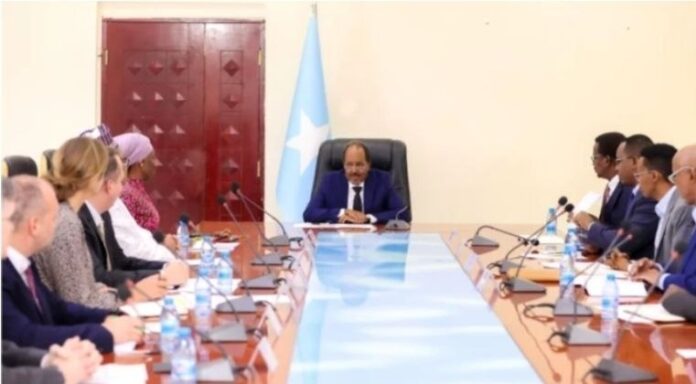
Somali President Hassan Sheikh Mohamud met with international partners on Tuesday to discuss the escalating political tensions surrounding the country’s electoral process, as diplomatic efforts intensify to bridge the widening gap between the government and opposition factions.
This high-level meeting came just one day after international representatives held separate talks with opposition leaders, focusing on ways to ease the electoral standoff and foster political consensus. According to officials familiar with the discussions, President Mohamud briefed the diplomats on the federal government’s electoral agenda, which centers on implementing nationwide direct elections under the “one person, one vote” system.
The Somali government has firmly insisted that future members of parliament must be elected through universal suffrage, replacing the country’s longstanding indirect electoral model. Deputy Prime Minister Salah Ahmed Jama recently briefed the Somali public on negotiations between the Federal Government and opposition groups, stating that the principle of democratic elections has largely been agreed upon, with remaining differences confined to the technicalities of executing the “one person, one vote” system rather than the principle itself.
Assuring the public, Jama stated: “These elections will give Somalis the opportunity to decide their own future through the ballot box,” describing the transition from the indirect, delegate-based model that has chosen representatives since the adoption of the interim constitution in 2012 toward direct elections founded on universal suffrage.
The government has described this transition as a democratic revolution, while the opposition has pressed to see the process defined in agreed and transparent terms. The National Independent Electoral and Boundaries Commission (NIEBC) has already begun voter registration and card distribution in phases across the country, extending in recent days to districts such as Harardhere in the Mudug region.
The opposition, however, has called for broader political consensus on the electoral framework, arguing that unresolved disagreements could deepen the country’s political crisis. Opposition lawmaker Abdirahman Abdishakur Warsame of the Somali Future Council warned that allowing a government to remain in office beyond its mandate without a caretaker arrangement undermines the legitimacy of state institutions.
In response to the political impasse, opposition groups have submitted their own electoral proposals. The Somali Future Council accepted for the first time that Somalia should move toward direct elections in which voters choose members of Parliament. However, the coalition proposed that the federal government’s political party system not be used in the election, instead calling for voting based on the 4.5 power-sharing formula while maintaining the current
The opposition proposal calls for elections to be held in four districts in each federal member state, with the process managed jointly by a federal-level electoral committee and a committee from the state where voting is taking place. The coalition has proposed that voting be held in a single day using paper ballots rather than an electronic voting system.
The latest diplomatic engagements underscore growing international efforts to encourage dialogue between Somalia’s political stakeholders as the country seeks agreement on its electoral roadmap. International partners—including the United States, United Kingdom, European Union, United Nations, and Turkey—have been actively involved in facilitating talks.
Recent negotiations have focused on each side submitting preferred electoral models, with four different electoral models presented to mediators. During talks in July, the federal government and opposition groups agreed on three basic principles: preserving clan quotas, maintaining the 30% women’s quota, and holding elections based on one person, one vote.
However, the parties have not yet begun detailed discussions on the main disputed issues, including which constitutional framework should guide the elections, which electoral model to adopt, and which electoral commission should manage the vote. The federal government wants elections based on the Constitution approved in 2026, while opposition groups insist that the 2012 Provisional Constitution should remain the basis.
The political impasse stems from constitutional amendments backed by the federal government that critics say could extend President Mohamud’s term by one year and delay federal elections until 2027. Somalia’s presidential election was due in May, after Parliament’s mandate expired in April, but the vote has been thrown into uncertainty by disagreements over the electoral framework.
Western diplomats have expressed concern to President Mohamud over the handling of the country’s political transition, urging authorities to engage in meaningful dialogue and reach an election agreement acceptable to all stakeholders.
Sources said the envoys warned that any outbreak of violence linked to political disputes could prompt international action against the parties deemed responsible, while also signaling that Somalia’s state-building efforts could not rely indefinitely on external financial support.