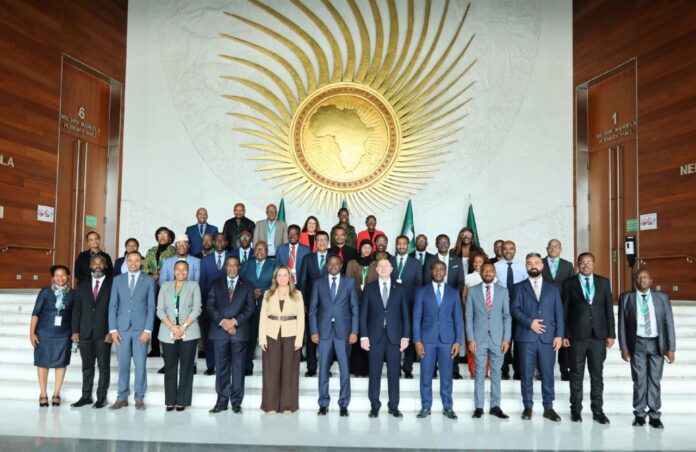
In a decisive effort to position the African continent at the forefront of global climate finance, a high-level training seminar on the African Carbon Market took place at the African Union Headquarters on July 8, 2026. This critical institutional initiative successfully brought together more than 80 prominent participants, including African Ambassadors, senior diplomats accredited to the African Union (AU), and key policy experts from across the region.
The intensive seminar was jointly conducted by the African Union Commission (AUC) and the African Capacity Building Foundation (ACBF), with strategic international backing from the Government of Azerbaijan through the Azerbaijan International Development Agency (AIDA). This high-level session represents a vital operational step toward establishing unified, technically grounded African leadership within the rapidly evolving global green economy.
The training was strategically organized to accelerate the implementation of the Africa Action Plan on Carbon Markets (AAPCM), which was formally endorsed by the AU Assembly in 2025 to serve as the continent’s official roadmap for navigating carbon trading structures.
This capacity-building convention arrives at a pivotal moment for international climate diplomacy, following the landmark decisions adopted under Article 6 of the Paris Agreement at the COP29 summit in Baku. Because these newly established mechanisms are projected to unlock up to US$1 trillion annually in climate finance by 2050, carbon markets have rapidly transformed from niche environmental instruments into cornerstones of global economic and geopolitical strategy. Consequently, the training focused intensively on ensuring Africa’s primary diplomatic emissaries possess the technical, policy, and strategic insights required to champion these complex frameworks.
During the High-Level Opening, Moses Vilakati, the AU Commissioner for Agriculture, Rural Development, Blue Economy and Sustainable Environment, delivered a sobering reminder of what is at stake, emphasizing that continental frameworks must strictly dictate how these financial mechanisms are utilized. Commissioner Vilakati stated that the collective approach must safeguard ecosystem integrity, ensure genuine Free, Prior and Informed Consent (FPIC), and guarantee transparent, legally enforceable benefit-sharing with indigenous peoples and local communities.
He warned that without strong governance and effective oversight, carbon markets risk facilitating greenwashing for heavy emitters while generating limited development benefits for African countries. By prioritizing robust internal oversight, the AUC and ACBF aim to protect African ecosystems from exploitation while ensuring that capital inflows translate into tangible, sustainable development.
The critical theme of ownership and technical mastery was strongly echoed by Ambassador Laho Bangoura, Special Adviser to the Executive Secretary & Head of the AU Liaison Office for the ACBF. Ambassador Bangoura noted that building deep-rooted technical capacity is the only way for the continent to protect its long-term interests, stating that as climate finance becomes increasingly central to Africa’s development agenda, capacity development must remain at the heart of the response because when Africa has the right capacities, Africa can better shape its own future.
Throughout the day, diplomats moved beyond theoretical discussions to engage with concrete technical case studies of successful, African-led carbon projects. They analyzed the operational mechanics separating compliance markets from voluntary markets, evaluated the structural replicability of advanced regulatory frameworks like the European Union’s Emissions Trading System (ETS), and focused heavily on ensuring that revenues generated from carbon trading are structurally directed to fund climate adaptation and empower local populations.
As global demand for premium, high-quality carbon offsets intensifies toward 2030, this high-level training ensures that Africa can negotiate on the global stage with a single, highly competent, and technically grounded voice. The collaboration with Azerbaijan underscores the strengthening ties between African institutions and international climate leadership.
Ruslan Nasibov, Ambassador of the Republic of Azerbaijan, highlighted his country’s ongoing solidarity with developing nations, noting that as the Presidency of COP29, Azerbaijan consistently sought to ensure that the voices and priorities of climate-vulnerable countries remained at the center of the global climate agenda. By fortifying the technical capabilities of its diplomatic corps, the AUC, ACBF, and their partners have successfully laid down the structural foundation for an African green transformation that serves both ecological resilience and continental economic growth.
The organizational success of this seminar relies on the distinct capabilities of its partner institutions, notably the African Capacity Building Foundation (ACBF), which serves as the premier institution for capacity development across Africa. As a Specialized Agency of the African Union with over 33 years of experience, ACBF designs and implements programs aimed at building economic resilience, advancing sustainable trade, strengthening food sovereignty, and promoting effective governance in alignment with the AU’s Agenda 2063. Working alongside the foundation is the African Union Commission (AUC) Directorate of Sustainable Environment, which holds the core mandate for executing the AU Climate Change and Resilient Development Strategy and Action Plan.
This directorate supports Member States in building transparent, high-integrity carbon governance structures under the Paris Agreement to mobilize climate finance and protect community rights. Finally, the initiative was bolstered by the Azerbaijan International Development Agency (AIDA), an arm operating under the Ministry of Foreign Affairs of Azerbaijan that delivers international development assistance to promote global safety, sustainability, and resource mobilization in developing economies.