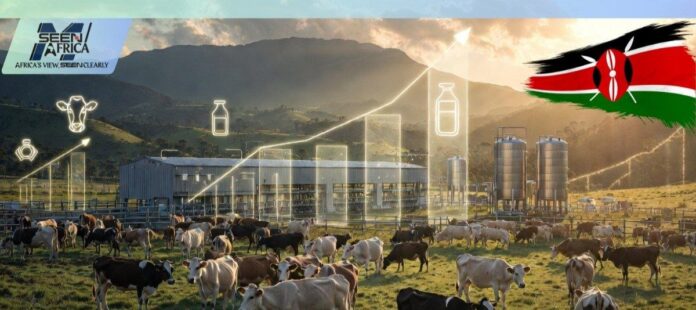
Kenya has officially surpassed Egypt to become the largest producer of milk in Africa. Formally announced by the Ministry of Agriculture and Livestock Development, the country’s annual milk output has surged from 4.6 billion liters to a record-breaking 5.4 billion liters.
This massive expansion has permanently established Kenya as the continent’s premier dairy powerhouse, signaling a profound shift in the regional economic landscape.
Driven by a rapidly growing dairy herd, improved animal husbandry, and advanced breeding technologies, this production boom marks a transition for the local dairy value chain. Moving away from traditional low-yield subsistence farming, the sector has embraced heavy, automated agro-industrial output. Backed by presidential directives that successfully lowered cost barriers for specialized inputs, the shift protects rural livelihoods across more than 1.8 million smallholder households while positioning the nation to command cross-border dairy trade networks across sub-Saharan Africa.
The rise of Kenya to the absolute apex of Africa’s dairy rankings transitions the regional agricultural landscape away from traditional open-grazing systems toward data-driven genetic engineering, automated cold-chain logistics, and strict regulatory value chain structures. As regional urban populations expand and demanding consumer markets seek processed dairy assets, the deployment of targeted state-backed interventions has enabled local producers to lift average daily yields per cow by approximately three liters, significantly maximizing farm-level margins and operational efficiency.
The core policy modernizations, breeding technologies, and infrastructure rollouts driving this historic continental milestone focus on four primary pillars. First, the state deployed mass livestock vaccination programs to reduce disease prevalence. By minimizing the localized spread of foot-and-mouth disease, the State Department for Livestock Development has insulated active dairy herds from physical health shocks, lifting milk production baselines predictably.
Second, the government scaled up accessible sexed semen breeding technology via executive directives. A central factor behind the herd expansion was a presidential directive that slashed the price of high-yield sexed semen from KSh 8,000 down to KSh 1,000 per dose. This critical subsidy enables smallholders to produce female calves with 95 per cent accuracy, rapidly building high-quality, future milk-producing herds that sustain long-term growth.
Third, the government focused on distributing bulk milk coolers to combat perishable post-harvest losses. To protect morning milk outputs from rapid spoiling, the state has rolled out subsidized cold-storage assets to leading rural dairy cooperatives. Expanding this local cold-chain infrastructure improves milk quality and significantly strengthens farmer pricing power during transport delays, ensuring that more product reaches the market safely.
Finally,the government is enforcing quality-based milk payments and streamlining regulatory value chains. Cabinet Secretary Sen. Mutahi Kagwe has advanced a nationwide rollout of Quality-Based Milk Payment (QBMP) models. By rewarding farmers based on fat and protein contents rather than mere volume, the sector is moving toward formal market lines. This is paired with a strict regulatory tracking loop to manage unregulated milk hawking, ultimately improving public health safety and industry standards.