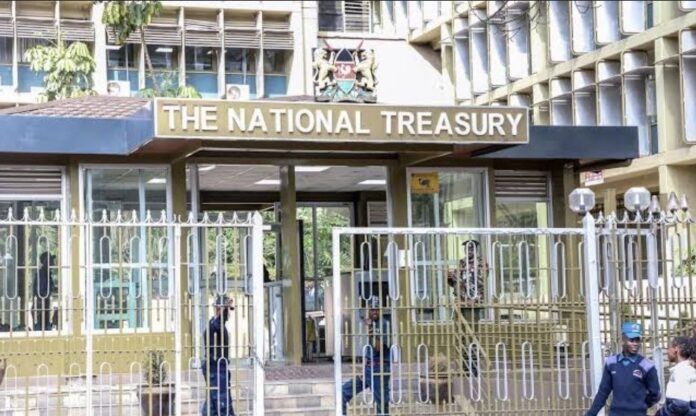
The National Treasury of Kenya has announced plans to introduce a new Ksh145.6 billion Eurobond (equivalent to USD 1.12 billion) to the international market for the 2026/27 financial year. This strategy aims to plug a widening budget deficit and ease external debt repayment pressures. The sovereign bond stands as a cornerstone of the external borrowing strategy developed by Treasury Cabinet Secretary John Mbadi to stabilize the country’s economic framework.
This new Eurobond issuance plan is designed to counter a major wave of upcoming debt repayments. According to Treasury data, the primary objective is to refinance an existing Ksh194 billion (USD 1.5 billion) note maturing in 2031, which carries an expensive interest rate of 9.75 percent. Although the Kenyan government utilized an extended maturity date of 2031 to manage a USD 2.0 billion debt maturity back in February 2024, gradual repayments for this loan are set to begin in 2029, leaving the Treasury no choice but to seek fresh funding sources without delay.
In the current 2025/26 financial year, Kenya managed to raise Ksh62.5 billion under supplementary budget estimates by utilizing a Yen-denominated instrument popular in Japanese capital markets known as a “Samurai Bond.” However, this Samurai Bond does not feature in the 2026/27 borrowing plan, indicating that the instrument served as a one-off refinancing tool rather than a permanent fixture in the nation’s debt management strategy.
On the multilateral front, the Kenyan Treasury has budgeted to receive Ksh170.5 billion through a World Bank Development Policy Operation and Ksh21.3 billion via a similar facility from the African Development Bank (AfDB). The World Bank’s support combines Ksh44 billion (USD 340 million) from the International Bank for Reconstruction and Development (IBRD) and Ksh53 billion (USD 410 million) from the International Development Association (IDA), with board approval expected within this month.
Additionally, project loans remain a significant component of the external financing strategy. Accordingly, Project Loans Appropriations in Aid (Project Loans A-I-A) will contribute Ksh75.3 billion, while Project Loans Revenue will add Ksh116.3 billion to the external financing plan for the financial year.
Overall, however, Kenya’s net foreign financing projection for 2026/27 stands at just Ksh116.2 billion. This represents a sharp decline compared to the Ksh225.8 billion recorded in last year’s supplementary budget, signaling that international borrowing conditions and criteria facing the country are becoming increasingly tight.
Domestically, the Treasury plans to raise Ksh1.03 trillion through government securities to support a fiscal framework already stretched by deficits. However, with the country’s total public debt obligations through the Consolidated Fund Services (CFS) hitting Ksh2.56 trillion, economic analysts note that Kenya’s macroeconomic and budgetary management will inevitably face severe pressure in the coming years.