The Government of Eritrea has formally rejected a report presented to the United Nations Human Rights Council criticizing the country’s human rights record, describing it as fundamentally flawed in its methodology, unsupported by independently verified information, and disconnected from the realities on the ground.
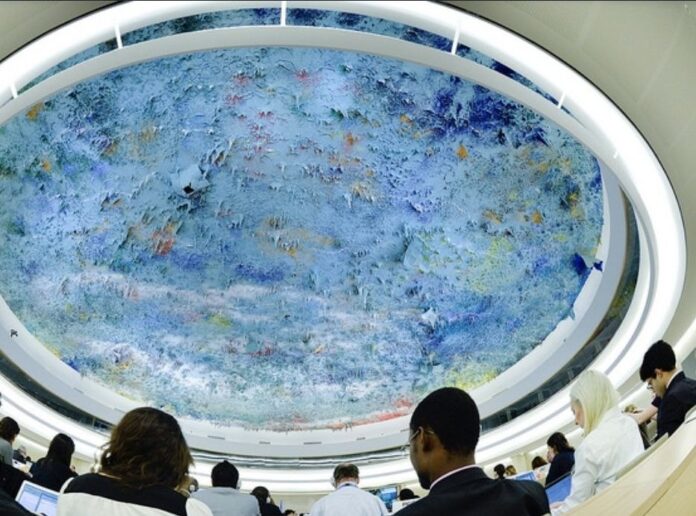
This position was delivered during the Enhanced Interactive Dialogue on the Situation of Human Rights in Eritrea held in Geneva. Speaking at the forum, Ambassador Sophia Tesfamariam, Eritrea’s Permanent Representative to the United Nations in Geneva, stated that the report’s findings and conclusions lack credibility and therefore cannot serve as a reliable basis for informed deliberation or action by the Council.
Ambassador Sophia Tesfamariam strongly argued that the core methodology underpinning the Special Rapporteur’s report remains deeply problematic. According to the Ambassador, the report relies heavily on anonymous and unverified sources while completely ignoring tangible progress documented by UN agencies and other institutions in Eritrea’s health, education, food security, infrastructure, and socio-economic development sectors.
Noting that Eritrea has consistently responded to these unsubstantiated allegations repeated year after year, the representative declared “Repetition does not constitute evidence, nor can it transform contested narratives into established fact.”
She condemned the report for giving disproportionate weight to claims advanced by a narrow circle of external actors, which are often elevated to established facts without adequate scrutiny or corroboration. This, she argued, distorts the analytical framework and violates the principles of objectivity, balance, and evidentiary rigor expected in UN reporting.
The Ambassador also provided a detailed explanation regarding Eritrea’s National Service Programme, an institution that is frequently singled out for international criticism. She noted that the program was established under Proclamation No. 82/1995 as a sovereign institution designed to safeguard the nation’s independence, territorial integrity, and national security, while fostering social cohesion and self-reliance.
She pointed out that the continuation of the service beyond the statutory 18 months has been shaped by persistent external security threats and unresolved regional tensions. Furthermore, she reminded the Council that a growing number of states, including several European countries, are currently reviving, expanding, or actively debating forms of national service and conscription in response to evolving global security challenges. Despite this, Eritrea continues to be denied the same sovereign prerogative afforded to others, reemphasizing that the duration and structure of the programme remain a matter for Eritrea alone to determine based on its own national circumstances.
Ambassador Sophia criticized the Special Rapporteur for questioning African states that have exercised their sovereign right to reach conclusions different from his own. She stated that a Special Rapporteur’s mandate is solely to assess a country’s situation, not to police or question the independent diplomatic positions of Member States within the Council.
She noted that while African states are criticized for questioning the mandate, the Council fails to reflect on the implications of coordinated voting patterns by penholders, including European Union Member States. She explained that divergent views are a normal feature of multilateral diplomacy and should be seen as evidence of independent judgment rather than a cause for concern. She highlighted that despite decades of conflict, sanctions, and external pressures, Eritrea has maintained its sovereignty, preserved social stability, and continued the delivery of essential services—a reality fundamentally inconsistent with the bleak picture repeatedly presented by the mandate.