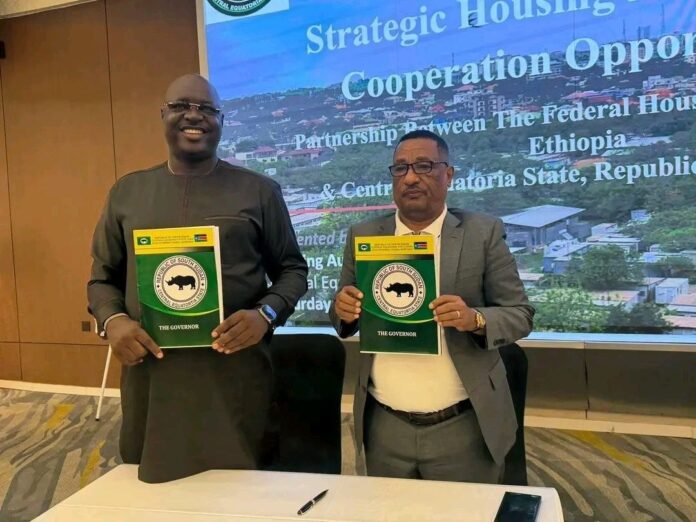
Ethiopia’s state-backed property developer, the Federal Housing Corporation (FHC), has finalized all preliminary benchmarks and is structurally positioned to break ground on a massive, multi-phased modern housing development venture in Juba, South Sudan.
The ambitious real estate initiative officially transitioned from diplomatic framework to actionable mandate following the signing of a comprehensive operational contract in the South Sudanese capital. This newly executed binding agreement effectively operationalizes a prior Memorandum of Understanding (MoU) brokered between the two entities in Addis Ababa, formalizing the legal, logistical, and economic structures required to deploy Ethiopian public sector engineering capabilities directly into South Sudan’s expanding property market.
The accord was formally signed during an official ceremony by Dr. Reshad Kemal, Chief Executive Officer of the Federal Housing Corporation, and Emmanuel Adil, the Governor of South Sudan’s Central Equatoria State. Under the provisions of this strategic partnership, the FHC will spearhead the complete lifecycle development of high-density modern commercial complexes and residential apartments. The integrated urban blueprint is tailored explicitly to address the acute structural deficit in high-quality housing and business infrastructure currently facing the rapidly expanding population of Juba.
Operational mobilization is already moving at an advanced pace. Well ahead of the formal signing, a exhaustive engineering and socio-economic study report compiled by Central Equatoria State’s own Construction and Housing Corporation was submitted to the FHC leadership for technical evaluation.
Following a rigorous review of urban zoning, soil mechanics, and utility access vectors, joint technical committees have finalized definitive building site selections across Juba’s primary expansion corridors. This conclusion of essential pre-construction assessments eliminates the standard logistical bottlenecks that frequently delay cross-border real estate investments, clearing the path for heavy machinery deployment and civil works.
On the sidelines of the signing protocols, Dr. Reshad held high-level, closed-door consultations with South Sudanese Special Envoy, Adut Kiir, alongside Ethiopia’s Ambassador to South Sudan, Delil Kedir, and prominent regional investor Dr. Aysheshim Teka, to solidify the requisite inter-governmental and financial protective frameworks.
During these deliberations, Special Envoy Adut Kiir reaffirmed that South Sudan’s federal apparatus is fully mobilized to extend all necessary sovereign guarantees, administrative clearances, and security protocols to safeguard the FHC’s capital deployment. She expressed unwavering confidence that breaking ground on these physical structures will serve as a tangible monument to the historic, brotherly, and deeply intertwined bilateral relations shared between Ethiopia and South Sudan, elevating their economic cooperation to an unprecedented milestone.
Addressing stakeholders and media representatives, Dr. Reshad underscored that the FHC’s entry into the South Sudanese property market is not merely a commercial real estate transaction, but an intervention anchored firmly on the core geopolitical principles of mutual benefit, regional integration, and East African solidarity.
“The Federal Housing Corporation is bringing more than just capital investment across the border,” Dr. Reshad stated. “We are deploying institutional technical expertise, sustainable architectural practices, and advanced, modern pre-fabricated building technologies optimized for rapid, high-durability execution.”
Dr. Reshad further disclosed the strategic phased rollout of the multi-million-dollar venture. The initial phase of the construction campaign will concentrate its resources exclusively within Central Equatoria State to establish proof-of-concept models and streamline regional supply chains.
Once these anchor projects in Juba reach operational maturity, the FHC intends to scale the development framework outward, replicating the modern housing models across other primary cities and economic hubs throughout South Sudan.
Governor Emmanuel Adil framed the partnership as a critical cornerstone of the state administration’s aggressive policy push to reform, upgrade, and transform Juba from a rapidly growing settlement into a highly modernized, meticulously planned, and sustainable metropolis. He noted that the influx of structured development will dramatically accelerate the modernization of municipal infrastructure services, including localized road networks, sanitation channels, and power grids integrated directly into the new building complexes.
Furthermore, Governor Adil emphasized that the predictable execution model of Ethiopia’s FHC will inject much-needed stability into the local real estate ecosystem, creating a benchmark for construction quality and establishing robust secondary investment opportunities for domestic contractors, material suppliers, and skilled laborers.