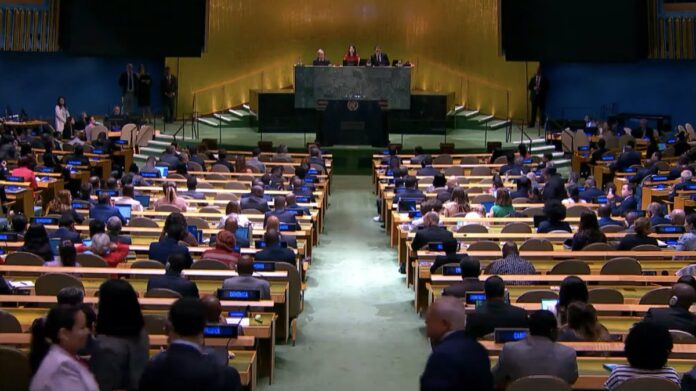
The 85th plenary meeting of the United Nations General Assembly focused heavily on key issues aimed at steering multilateral diplomacy back on track. During this historic session, the member states elected the leadership that will guide the organization for the upcoming 81st session of the General Assembly. Among the nations chosen to assume the Vice-Presidency was the East African nation of Eritrea, which was elected with a strong majority of support.
Eritrea, along with 16 other newly elected nations, will join the five permanent members of the Security Council—China, France, the Russian Federation, the United Kingdom, and the United States—to collectively form and lead the Bureau of the General Assembly.
This election is widely viewed as a significant political achievement for Eritrea. It elevates the country’s influence and role in the international arena and the diplomatic field at a crucial time when it is actively engaged in addressing various challenges both within the Horn of Africa and globally. Alongside Eritrea, nations such as Afghanistan, Finland, Egypt, Lebanon, Paraguay, and Zimbabwe were also elected to serve as Vice-Presidents.
During the secret ballot voting conducted on the same day, Khalilur Rahman, the current Foreign Minister of Bangladesh, was elected as the President of the 81st session of the General Assembly. Mr. Rahman secured the presidency by obtaining 99 votes, narrowly defeating his opponent, Andreas Kakouris of Cyprus, who received 91 votes.
The President-Elect, who will officially assume his duties at the end of August, addressed the Assembly following his victory. He emphasized that the global organization is currently confronting a severe financial crisis and a deepening deficit of international trust. He stressed that member states must collectively demonstrate that the UN can adapt, reform, and deliver better results. He noted that the organization must justify every penny contributed by its members in order to restore lasting trust in the institution.
President-Elect Khalilur Rahman acknowledged that his tenure begins at a moment when the world is being tested on multiple fronts. He cited the proliferation of wars and shared conflicts, backsliding in human rights, worsening poverty, and the regression of development gains as the premier challenges facing the international community today.
Regarding the 2030 Agenda for Sustainable Development, the incoming President declared that the gap between promise and delivery remains far too wide. He pointed out that the ongoing energy insecurity and price inflation, particularly affecting nations in the Global South, could potentially represent the worst energy crisis witnessed in the last 50 years. He affirmed his intention to work closely with member states to mitigate these threats and prevent another lost decade of development from devastating developing countries.
Furthermore, he pledged to focus heavily on promoting gender equality by empowering women, fostering the fair, safe, and beneficial use of artificial intelligence (AI) technologies, and upholding the core human rights principles of the General Assembly.
The outgoing President of the 80th session of the General Assembly, Annalena Baerbock of Germany, extended her congratulations to her successor, describing the position as one of the best yet most challenging jobs in the world. She pointed out that because global consensus is no longer a given in the modern era, the role of the General Assembly President has become increasingly critical. Illustrating the transition period with a sports analogy, she stated that electing a new President with three months left in the current tenure is like preparing for the next football match when the current game has only reached the 75th minute. She added that while no one knows definitely what will happen in the coming months, the two leaders will play the final part of the session together.
United Nations Secretary-General António Guterres also expressed his optimism, stating that the 81st General Assembly will be a moment of great challenges but also one of new possibilities. He underscored that the daily hard work of diplomacy, dialogue, and collaboration taking place within the General Assembly gives renewed hope that deep global divisions can be transformed into a shared determination to work for a common purpose.