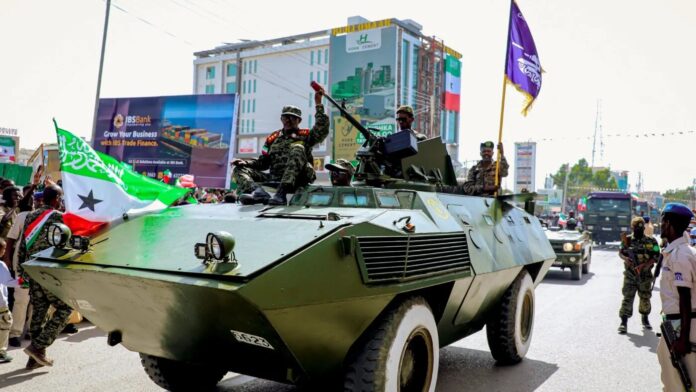
In a new report submitted to Congress, the United States Department of State has reaffirmed its recognition of Somalia’s sovereignty and territorial integrity, while outlining pathways to expand its engagement with Somaliland in the areas of security, diplomacy, and trade.
The two-page document, prepared under the 2026 State Department appropriations law, explicitly states that Washington recognizes “the sovereignty and territorial integrity of the Federal Republic of Somalia, which includes the region of Somaliland.” However, the report also notes that Washington maintains a “positive, constructive relationship” with authorities in Hargeisa and continues to explore additional opportunities for engagement. Officials clarified that this move does not signal a shift toward recognizing Somaliland, which has sought international recognition for over three decades since declaring independence in 1991. The Federal Government of Somalia firmly rejects Somaliland’s claim to statehood, maintaining that the territory remains an integral part of Somalia.
According to the report, security serves as the cornerstone of potential US cooperation with Somaliland. Characterizing the Horn of Africa’s security environment as “complex,” the document highlights rising extremist threats and regional disputes.
Somaliland’s proximity to Yemen and the critical Bab al-Mandab Strait positions it as a vital partner in safeguarding shared security interests, including ensuring the freedom of commercial and military navigation from the Red Sea to the Indian Ocean. Furthermore, the report notes that Somaliland could assist in monitoring and countering extremist networks, particularly potential connections between Houthi terrorists and al-Shabaab—the latter described by the State Department as “al-Qa’ida’s largest and wealthiest affiliate.”
The US Africa Command (AFRICOM) already maintains regular contact with Somaliland authorities. AFRICOM Commander General Dagvin Anderson visited Hargeisa and Berbera in November 2025 as part of a broader East Africa tour, which included evaluating the security environment and operational capacity of the Berbera port.
The report details that the US Embassy in Mogadishu conducts “regular, periodic visits” to Somaliland to discuss humanitarian aid, security, and economic matters. However, Washington’s engagement with Somaliland remains strictly tethered to its overarching Somalia policy. US officials traveling to the region are subject to the same stringent security requirements applied to the rest of Somalia, including the mandatory use of non-commercial aircraft and other resource-intensive security measures.
While Somaliland officials desire a more direct and robust relationship with Washington—with Somaliland’s Minister of the Presidency, Khadar Hussein Abdi, telling AFP in February that Hargeisa was ready to offer the US exclusive access to minerals and military bases—the State Department report stops short of accepting these offers, choosing instead to limit cooperation to practical, mutual interests.
The report highlights that the development of Berbera’s airport and seaport infrastructure presents a major opportunity for a regional trade corridor, serving not only Somaliland but also landlocked Ethiopia. This could unlock potential for US investment in infrastructure, exports, and commercial sectors.
However, the document also points out significant obstacles to deeper economic engagement, citing “regional security concerns and the dispute over Somaliland’s status” as challenges for banking, trade, and investment.
Notably, the report mentions Somaliland’s “refusal to cooperate with national authorities” as a barrier to investment—wording that is likely to be welcomed by officials in Mogadishu, who strongly oppose foreign dealings that bypass the central government.
In January 2024, Somalia rejected a Memorandum of Understanding (MoU) between Ethiopia and Somaliland that proposed sea access for Addis Ababa in exchange for potential recognition. Tensions later eased when Somalia and Ethiopia signed the Ankara Declaration in December 2024, pledging to respect each other’s sovereignty and territorial integrity.