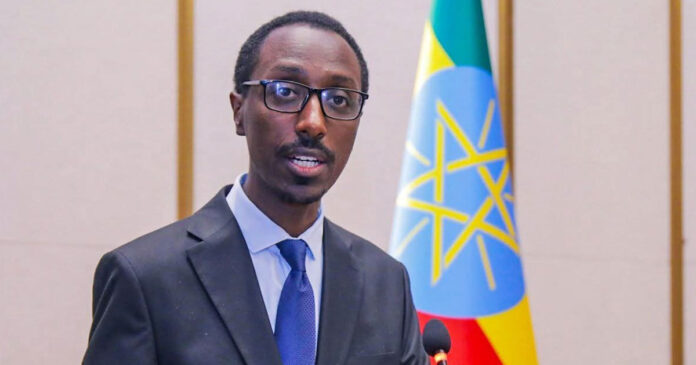
The fragmentation of the international order, escalating geopolitical rivalries, and the drying up of development aid are placing Africa’s development prospects in a highly challenging position, warned Ethiopia’s Foreign Minister, Gedion Timothewos. The Minister stressed that if the continent fails to cooperate and forge a unified front, it faces the stark risk of “sinking together.”
Gedion shared these insights in a detailed analysis published in the June 2026 issue of the prominent international financial magazine, Finance & Development. According to the Foreign Minister, “geopolitics is replacing globalization.” This means global economic decisions are increasingly driven by security concerns and strategic competition among major powers rather than open market principles.
Although the Minister did not explicitly name the Horn of Africa—a region of intense global rivalry comprising Ethiopia, Eritrea, Somalia, Djibouti, Sudan, and South Sudan—he pointed out that sub-Saharan African countries as a whole are being forced to navigate a fragmented international system.
This new era is characterized by intensifying geopolitical competition, a scramble for critical natural resources, shifting trade routes, and the gradual erosion of multilateral institutions.
Gedion argued that the international system which enabled Asia’s rapid, export-led industrialization (the “Asian Tigers”) “is no more.” This shift has severely constrained the ability of African nations to attract fresh investment and replicate similar growth paths.
Furthermore, the sharp decline in official development assistance (ODA) and the rise of conflicts across various parts of the globe have significantly starved the continent of essential development financing.
He also warned that competition for Africa’s critical minerals and transport corridors is accelerating, often in ways that undermine state sovereignty. As global peace and security frameworks weaken, the financial and logistical burdens of peacekeeping and humanitarian assistance are increasingly being shifted onto the shoulders of African states.
Nevertheless, the Foreign Minister believes that this intense global competition could actually provide African nations with greater bargaining leverage. However, he emphasized that this opportunity can only be realized if countries are guided by clear, long-term strategies rather than short-term, transactional deals.
To achieve this, Gedion called for stronger African economic integration, noting that rapid urbanization, demographic growth, and emerging technologies like Artificial Intelligence (AI) present massive opportunities for the continent. To harness these prospects, however, major investments in infrastructure and digital connectivity are vital.
Using Ethiopia as an example, he recalled how the country’s earlier economic ambitions—inspired by the growth models of the Asian Tigers—were disrupted by external shocks and global crises. In response to these realities, Ethiopia has adapted its development approach by implementing sweeping reforms, diversifying economic sectors, and focusing heavily on domestic resource mobilization to align with the new global dynamics.
Gedion Timothewos underscored that Africa’s future depends entirely on coordinated and unified action among its nations. Maintaining that the continent can only withstand external geopolitical pressures by standing together, the Minister delivered a stark warning if this unity is not maintained, African states are bound to “sink or swim together.”