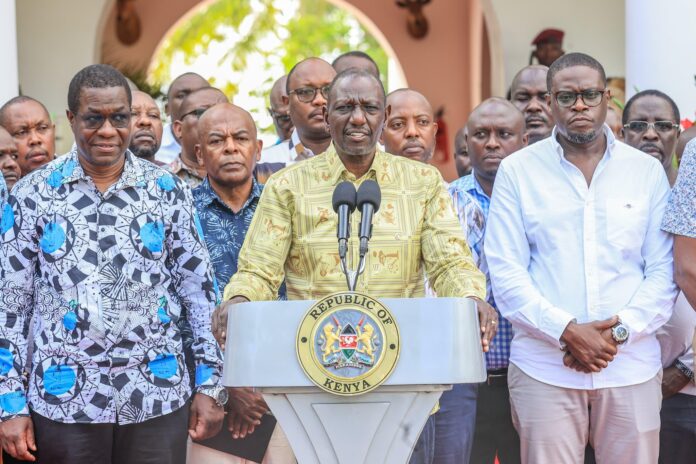
President William Ruto recently announced during a press briefing at State House Mombasa that his government will cease cutting fuel taxes. He explained in detail that this decision was necessitated by the government’s urgent need to gather sufficient financial capacity to sustain essential development projects such as road construction, schools, and hospital services.
The President strongly defended the government’s stance, asking which public services they should stop funding if they were to cease collecting this revenue entirely. He questioned whether the country should return to the spectacle of stalled road projects that had become a hallmark of the nation, or if they should halt the fertilizer subsidy program, emphasizing that hospitals and schools genuinely require funding.
President Ruto revealed that his government provided massive economic support amounting to a total of 28.19 billion Kenyan Shillings through direct price stabilization interventions and tax relief measures during the April-May and May-June 2026 pricing cycles to shield Kenyans from unmitigated economic hardship.
He noted that by reducing the Value Added Tax on petroleum products from 15 percent to 8 percent, the government sacrificed 14.43 billion Shillings in tax revenue to reduce pressure on Kenyan families and businesses.
According to the President’s explanation, without this government intervention, Super Petrol would have retailed at 230.12 Shillings per liter instead of 214.25 Shillings, Diesel would have retailed at 247.75 Shillings instead of 232.86 Shillings, and Kerosene would have skyrocketed to 270.00 Shillings instead of 191.38 Shillings.
Despite these constraints, he stated that he has directed the cost of diesel to be further reduced by 1 Shilling in the June-July cycle to provide additional relief to consumers. Government officials explained that the primary driver behind the current rise in fuel prices is the disruption of the global oil supply chain caused by ongoing tensions in the Middle East. Since nearly 20 percent of the world’s daily oil supply passes through this Gulf region, any disruption poses a major threat to global fuel distribution.
Consequently, global fuel prices rose sharply within just a few weeks, with prices increasing by 54.4 percent for Super Petrol, 18.5 percent for Diesel, and 126.4 percent for Kerosene. This energy cost crisis is a phenomenon that has tested not only Kenya but also the United States and Europe due to global supply disruptions.
Following a high-level consultative meeting with the Ministry of Transport, Energy, and transport stakeholders in Mombasa, President Ruto ordered an immediate review of the laws governing Kenya’s insurance industry and debt collectors.
The President pointed out the unfairness in the current system, stating that there are big transport operators who, despite having their own vehicles, leave their passengers to pay the bills when accidents occur while insurance companies go free.
Therefore, he directed that the review of insurance regulations and the Auctioneers Act within the next three months will serve to cushion stakeholders from heavy accident claims. In response to these productive engagements, the Federation of Public Transport Sector chairman, Edwin Mukabana, confirmed that the planned nationwide transport strike was officially called off with immediate effect as they chose to support the government agreements.
As part of long-term solutions to the fuel crisis, the government announced that Kenya and other East African Community nations are exploring ways to develop regional resources, including those in Turkana, and invest in regional refineries to reduce dependence on imported fuel.
The government also revealed plans to accelerate renewable energy adoption and electric vehicle programs, announcing that the first electric vehicles imported into the country will be duty-free. Furthermore, more than 3,000 electric vehicles are expected to be rolled out through government-supported programs to help combat the rising costs of fuel.