
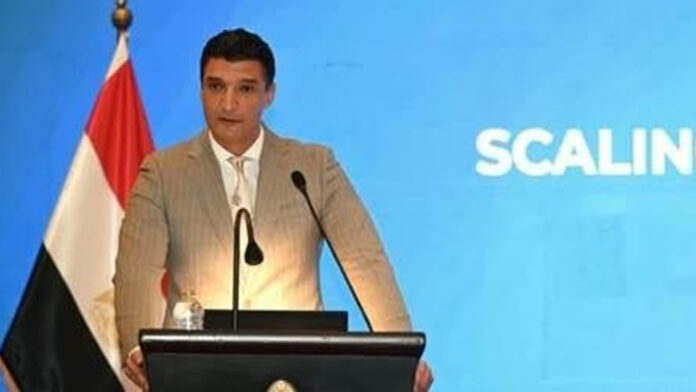
Egypt Minister of Industry Khaled Hashem said Tuesday that the African Continental Free Trade Area (AfCFTA) is one of the continent’s most important tools for boosting intra-African trade and economic integration, stressing that the ministry’s approach focuses on strengthening Egypt’s industrial capabilities and advancing integration with African industries and markets.
Hashem made the remarks during the opening of a forum organized by the International Cooperation Committee of the American Chamber of Commerce in Egypt, in cooperation with the African Export-Import Bank (Afreximbank).
The event was attended by Omar Mohanna, Chairman of the American Chamber of Commerce in Egypt; Oluranti Doherty, Director of Export Development at Afreximbank; Ahmed Maghawry, Assistant Minister of Industry for International Cooperation; and representatives of leading Egyptian companies, government entities, financial institutions and industrial partners.
The minister thanked the American Chamber of Commerce in Egypt and Afreximbank for organizing the event, which brings together business leaders and policymakers from across the continent.
He noted that the forum was particularly significant amid the profound transformations reshaping the global economy, driven by geopolitical developments, technological change and the restructuring of global supply chains.
Hashem said these developments present Africa with both challenges and opportunities, offering scope to strengthen industrial capabilities, expand regional trade, attract investment and achieve deeper integration into global value chains.
Citing Afreximbank’s African Trade Report 2026, he noted that Africa’s gross domestic product growth accelerated to 4.5% in 2025, while total merchandise trade reached around $1.5 trillion.
Intra-African trade amounted to approximately $214 billion in 2025, marking a 5.5% increase from the previous year, he said. Egypt accounted for about 4.4% of total intra-African trade, equivalent to around $9.3 billion.
While these figures reflect tangible progress, they also highlight the continent’s untapped potential through expanded manufacturing, value addition and the development of regional supply chains, Hashem added.
He said the AfCFTA provides one of the key mechanisms for realizing this potential, but stressed that expanding intra-African trade requires more than opening markets and reducing tariffs.
The minister’s remarks underscore Egypt’s broader push to position itself as an industrial hub linking African markets, leveraging its manufacturing base and geographic advantages to capture a larger share of the continent’s growing trade flows. The forum served as a platform for Egyptian companies and continental partners to explore avenues for deeper cooperation in manufacturing, export development and regional supply chain integration.
The AfCFTA, which entered into force in 2019, aims to create a single market for goods and services across the continent, covering more than 1.3 billion people and a combined GDP estimated at $3.4 trillion. Egypt has been an active participant in the agreement’s implementation, hosting the AfCFTA Secretariat’s dispute settlement body and pushing for expanded industrial cooperation among member states.
Hashem’s emphasis on industrial capability-building reflects a recognition that tariff liberalization alone will not deliver the agreement’s promised benefits without complementary investments in manufacturing capacity, infrastructure and regulatory harmonization. The ministry’s approach, he said, centers on equipping Egyptian industries to compete and integrate effectively within African markets, while also attracting investment into value-added sectors that can serve regional demand.
The forum, organized in cooperation with Afreximbank, highlighted the role of continental financial institutions in supporting trade expansion. Afreximbank has been a key financier of intra-African trade initiatives, including through its trade finance programs and support for industrial parks and export processing zones across member countries.
Participants discussed ways to translate the AfCFTA’s framework into practical gains for businesses, including addressing non-tariff barriers, improving trade logistics and facilitating access to finance for small and medium-sized enterprises seeking to expand into African markets.