President Yoweri Museveni has revealed that he firmly blocked a proposal by the Bank of Uganda to dip into the nation’s foreign exchange reserves in an attempt to stem the rapid depreciation of the Ugandan shilling against the US dollar.
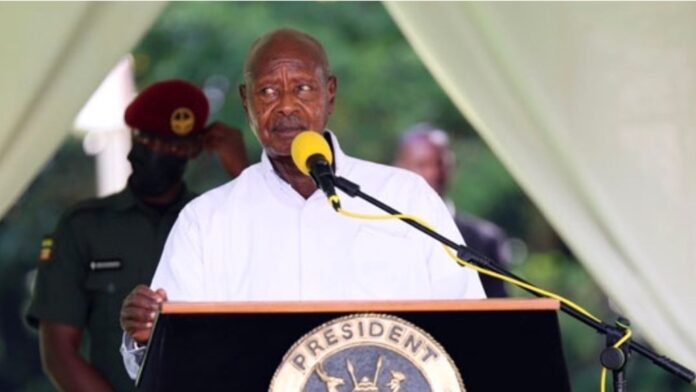
Speaking during national Independence Day celebrations, President Museveni argued that deploying the country’s foreign reserves to artificially defend the local currency would be fundamentally counterproductive. Instead, he championed a protectionist stance, noting that a weaker shilling paradoxically works to the advantage of local exporters while discouraging non-essential foreign imports.
The central bank had recently proposed drawing from Uganda’s estimated $6 billion in foreign exchange reserves to inject liquidity directly into the local market. Officials at the Bank of Uganda were optimistic that flooding the market with greenbacks would reduce soaring demand for the dollar, thereby allowing the sliding shilling to regain ground.
However, the President swiftly dismissed the intervention strategy. “I am totally against the Governor Bank of Uganda’s proposal to squander our reserves and deploy more dollars in the market to counter the falling shilling,” Mr. Museveni stated candidly. “This is not good. You cannot start helping people who are importing dead people’s hair. We shall minimize the imports.”
The President’s directive comes amid heightened economic pressure characterized by a weakening local currency and climbing fuel costs. By morning, the exchange rate had reached Shs4,011 per dollar, marking a sharp rise from the Shs3,700 rate recorded in late September.
Defending his rejection of the central bank’s plan, President Museveni emphasized that currency depreciation presents a distinct silver lining for the country’s export sector, even as it burdens importers.
“The depreciating shilling is good for exporters because they will earn more shillings when they exchange their dollars,” he explained. “It is the importers who are affected.”
While importers face steep costs for foreign goods, the administration appears intent on using market pressures to curb luxury and non-essential imports, steering the national economy toward self-reliance and domestic value addition.
Addressing the broader economic headwinds, Mr. Museveni attributed the surge in fuel prices and currency strain to a combination of geopolitical conflicts, shifting global capital flows, and domestic health challenges.
“When the Iran-America war started biting, I negotiated with Vitol to supply us fuel at subsidized prices, which they did for months. Now the war has persisted and fuel prices have gone high, so for now I want to assure Ugandans that everything will return to normal,” the President said, acknowledging that external economic shocks remain temporarily beyond immediate domestic control.
He also pointed to opportunistic foreign investors who bypassed local government bonds in favor of high-yield American markets, alongside localized health issues like Ebola, as contributing factors to the current financial tightrope.
Despite these hurdles, the Head of State strongly reassured the public that Uganda’s broader macroeconomic environment remains stable, anchored by manageable inflation rates. Highlighting the long-term economic track record of the National Resistance Movement (NRM) administration, he noted that Uganda’s Gross Domestic Product (GDP) has grown exponentially from $3.9 billion in 1986 to $69.3 billion as of June.
“We project that the economy will be at $74 billion. We are not yet there, but from our journey, we shall reach where we are going,” Mr. Museveni concluded, reiterating that the nation’s post-1986 economic strategy remains firmly built on five foundational pillars: recovery, expansion, diversification, value addition, and local enterprise growth.