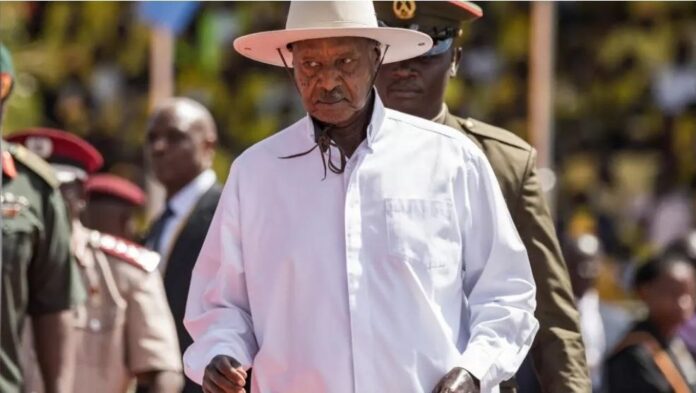
Uganda has officially given its emerging petroleum sector a distinct international identity, naming its export crude blend “Pearl Sweet” as the country prepares to transition into an oil-exporting nation. President Yoweri Museveni unveiled the formal designation during a ceremony in the western district of Hoima, marking a major milestone in a multi-year journey to bring the country’s commercial oil reserves to the global market.
The moniker “Pearl Sweet” blends national heritage with technical classification. The word “Pearl” honors Uganda’s historic description as the “Pearl of Africa,” while “Sweet” refers to the petroleum industry designation for crude oil with low sulphur content. Because low-sulphur crude requires less extensive processing and refining to remove impurities, it commands a favorable position among international buyers and refiners.
The commercial birth of Pearl Sweet is anchored by two primary upstream developments in the Lake Albert region: the Tilenga project, operated by French energy major TotalEnergies, and the Kingfisher project, managed by the China National Offshore Oil Corporation (CNOOC). Together, these sites are projected to achieve a peak production capacity of roughly 230,000 barrels per day. Energy officials noted that the initial site, Kingfisher, is slated to come online with an initial output of 28,000 barrels per day, while the larger Tilenga development is progressing rapidly toward its target operational phase.
Because landlocked Uganda requires a reliable mechanism to move its waxy crude to international buyers, the petroleum will be transported via the East African Crude Oil Pipeline (EACOP). Stretching 1,443 kilometers (897 miles) from Kabaale in Hoima down to the Tanzanian coast at Tanga, EACOP stands as the longest heated and electrically insulated crude pipeline in the world. Because Uganda’s heavy crude must be maintained at a stable temperature of 50 degrees Celsius to flow smoothly, the pipeline utilizes sophisticated tracing and insulation technology.
Despite the economic anticipation surrounding the project, the development has drawn intense scrutiny from international environmental groups and local communities. Critics have labeled the venture a “carbon bomb,” pointing out that parts of the infrastructure cut through fragile ecosystems, wildlife migration paths, and Murchison Falls National Park, where a portion of the project’s wells are situated. Human rights advocates and NGOs have also raised concerns over the displacement of more than 100,000 people, citing challenges regarding compensation transparency and the pace of relocation support.
In response, project operators maintain that stringent environmental mitigation hierarchies—aimed at avoidance, minimization, and offsetting—have been enforced, and that the vast majority of displaced households have already received compensation.
Addressing these milestones, President Museveni emphasized that the incoming oil revenues must be handled with strict fiscal discipline. He stressed that the finite wealth generated by Pearl Sweet should not fuel excessive consumption, but rather be funneled into permanent, productive national assets such as infrastructure, education, and electricity generation. In addition to export plans via the pipeline, a domestic refinery project is underway in Hoima to process petroleum locally, aiming to cut down costly fuel imports and bolster regional industrialization. With the infrastructure nearing completion, Uganda stands on the brink of reshaping its economic footprint on the global stage.