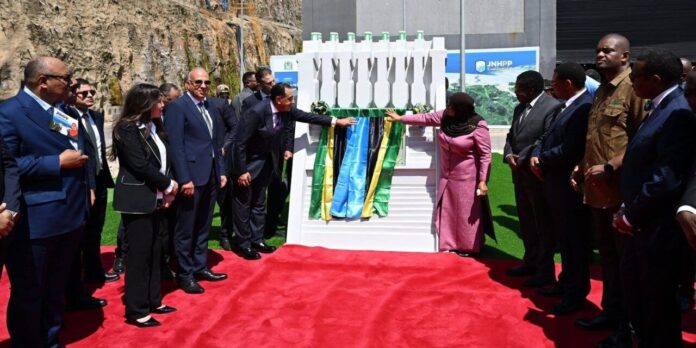
Tanzania officially inaugurated the $2.9 billion Julius Nyerere Hydropower Plant on Saturday. Constructed by a prominent Egyptian consortium along the Rufiji River, the mega-facility introduces a massive 2,115 megawatts of electricity to Tanzania’s national grid. This critical addition promises to fundamentally transform the nation’s overall energy security, power domestic industrialization, and significantly accelerate long-term regional economic growth across East Africa.
The official operational launch was led by Tanzanian President Samia Suluhu Hassan alongside Egyptian Prime Minister Mostafa Madbouly, who attended the ceremony on behalf of Egyptian President Abdel Fattah Al-Sisi under direct presidential instructions. Following a comprehensive joint inspection tour of the vast facility, both leaders unveiled a commemorative plaque to mark the completion of what has long been described as a monumental Tanzanian dream finally brought to life through African technical expertise.
Addressing the audience during the opening ceremony, Prime Minister Madbouly delivered warm greetings from President Al-Sisi to President Hassan and the Tanzanian people. He highlighted the project as a testament to what African nations can accomplish through shared vision and strategic collaboration. Madbouly noted that the massive structure stands as concrete proof of Tanzania’s resolute political will and Egypt’s high-level engineering capabilities, while reaffirming Cairo’s full readiness to continue expanding development partnerships across the continent to build a better future.
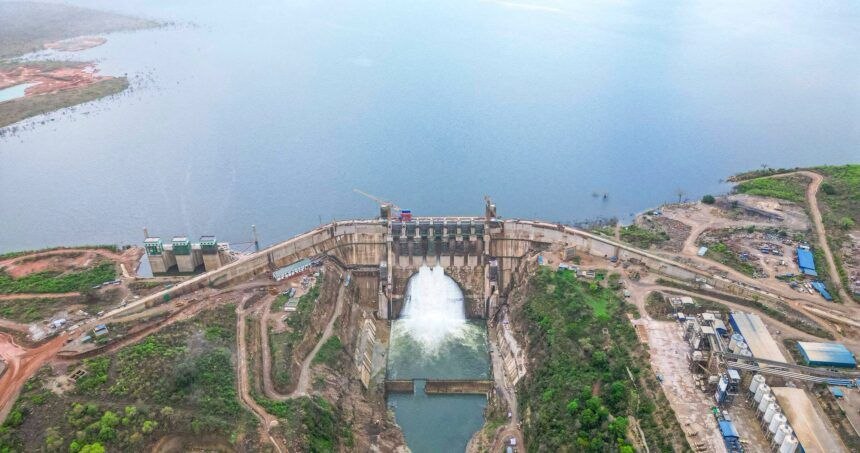
Madbouly expressed deep gratitude to the joint Egyptian consortium, comprising Arab Contractors and Elsewedy Electric, for delivering one of the three largest dams on the African continent. Completing the complex civil engineering project over 42 months of intensive labor demonstrates the capacity of Egyptian companies to execute mega-scale international infrastructure projects, particularly within Africa’s expanding energy sector.
The engineering scale of the facility reflects its immense utility. The main concrete gravity dam spans 1,036 meters in length and reaches a height of 131 meters, featuring a crest bridge connecting both banks of the Rufiji River. The dam retains a reservoir capacity of 34 billion cubic meters of water managed by seven primary spillway gates. Power generation relies on nine massive water turbines producing 235 megawatts each to achieve the full total capacity, with electricity routed through an advanced 400-kilovolt switchyard directly into the national grid via the Chalinze 1 and Chalinze 2 high-voltage transmission lines.
Beyond immediate power generation, both leadership teams signaled that the dam marks a new chapter in bilateral economic relations. Building on momentum from prior diplomatic engagements in Dar es Salaam, Prime Minister Madbouly called for a qualitative leap in mutual trade and investment. Leaders from both nations continue to explore expanding joint ventures across key growth sectors, including road construction, maritime transport, logistics, agriculture, pharmaceuticals, and renewable energy.
The ceremony brought together top dignitaries, including Tanzanian Vice President Emanuel John Nchimbi and Egyptian Water Resources Minister Hani Sewilam, reinforcing a shared commitment to regional stability and cooperative development throughout the Nile Basin.