Somalia is currently confronting a catastrophic hunger crisis driven by recurring drought, ongoing internal conflict, and an unprecedented, sharp drop in international aid. Humanitarian agencies are issuing urgent warnings that the country is rapidly sliding toward conditions that closely mirror its near-famine emergency of 2022. However, unlike the previous crisis, international organizations are now attempting to manage this escalating disaster with only a tiny fraction of the financial support required to effectively stave off widespread starvation and loss of life.
The defining and most dangerous feature of this unfolding disaster is a dramatic retreat by global donors. During the severe 2022 drought, international partners successfully mobilized approximately $2.2 billion for humanitarian relief, a massive financial push that proved vital in preventing a formal famine declaration.
Today, however, the financial landscape looks entirely different and deeply concerning. United Nations tracking data indicates that only about $289 million has been secured for Somalia’s response so far. Consequently, the national Humanitarian Needs and Response Plan remains less than one-third funded, leaving more than 70% of essential life-saving requirements completely unmet.
Médecins Sans Frontières (MSF) has reported that funding specifically dedicated to acute malnutrition programs has plummeted by over 80%. Historically major international contributors—including the United States, which provided roughly $70 million in 2025—have drastically reduced or entirely halted their financial backing for these critical programs this year. This sudden withdrawal has left frontline medical personnel and humanitarian aid operations severely strained and unable to meet the overwhelming scale of need.
This severe funding shortfall collides directly with rapidly worsening, desperate conditions on the ground. Recent joint government and UN assessments project that roughly 6.5 million people across the country currently face crisis-level hunger or worse, threatening the stability and survival of entire communities.
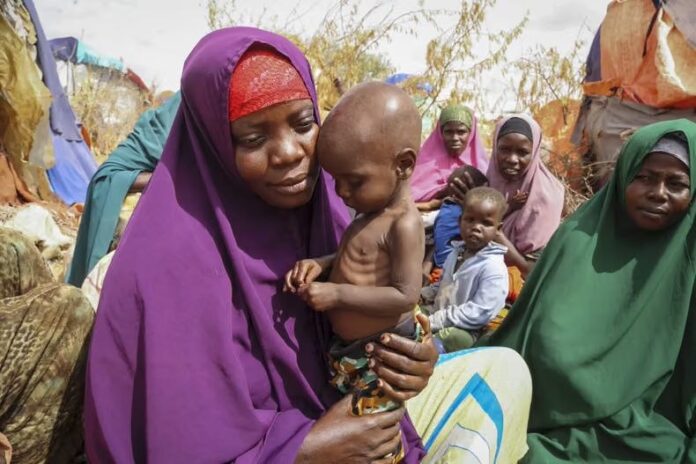
Within this vulnerable population, 1.8 million children under the age of five are expected to suffer from acute malnutrition. Furthermore, nearly 500,000 children are at immediate risk of severe acute malnutrition, while 3.4 million people remain internally displaced from their homes.
At MSF-supported medical facilities, admissions for malnutrition-related conditions have spiked by more than 80% compared to last year, already surpassing 22,000 cases. In Baidoa, a critical hub for displaced populations located in southwestern Somalia, health screenings reveal an alarming reality: half of the children living in displacement camps are acutely malnourished, and one in every four children is facing severe, life-threatening conditions.
The humanitarian emergency is heavily exacerbated by deep structural vulnerabilities within the nation. Successive poor rainy seasons have devastated local crops, decimated livestock herds, and severely depleted vital water supplies across the country. Because agriculture and pastoralism form the absolute backbone of Somalia’s traditional economy, these cascading agricultural losses simultaneously wipe out household savings, slash food availability, and destroy rural purchasing power.
These intense climate-induced pressures are further compounded by ongoing, long-running conflict with al-Shabaab, which routinely disrupts local trade, farming routes, and humanitarian access across vulnerable regions. The combination of environmental collapse and insecurity creates an environment where recovery is nearly impossible for local families without external assistance.
The withdrawal of foreign assistance has also rippled destructively through Somalia’s broader national economy. According to World Bank reports, significant reductions in security and humanitarian grants caused external official grants to drop by 4.2 percentage points of GDP, widening the country’s current-account deficit to 9.6%. This expanding economic pressure directly threatens recent hard-won developmental milestones, such as the December 2023 completion of the IMF and World Bank’s Heavily Indebted Poor Countries initiative, which had successfully unlocked $4.5 billion in much-needed debt relief.