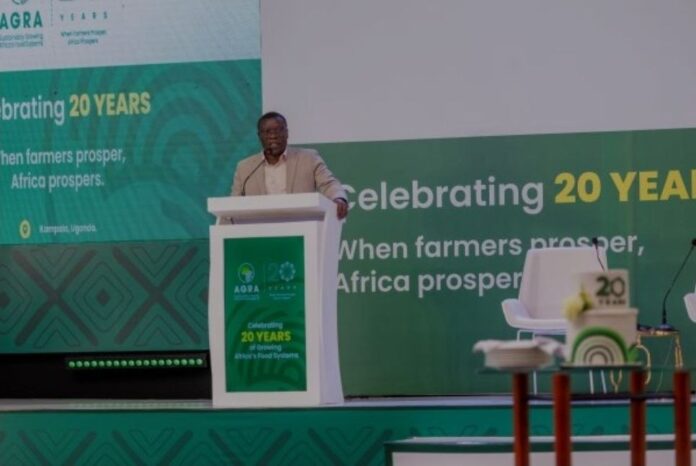
As Uganda looks to solidify its position as a regional powerhouse in agriculture, leaders and stakeholders recently gathered at the Kampala Serena Hotel to mark the 20th anniversary of the Alliance for a Green Revolution in Africa (AGRA). The national dialogue served as a critical forum to assess two decades of progress and, more importantly, to chart a strategic path forward that addresses the persistent hurdles preventing the country’s vast agricultural potential from translating into widespread prosperity.
Central to the discussions was a pressing call to action: Uganda must bridge the widening gap between high-level agricultural research and the actual implementation of these innovations on the ground. While the country boasts a robust research system, participants emphasized that the true measure of success lies in how effectively these technologies reach the farming communities that need them most.
During the dialogue, Dr. Patience Rwamigisa, Commissioner for Extension Coordination at the Ministry of Agriculture, Animal Industry and Fisheries (MAAIF), highlighted the disconnect between laboratories and fields. “We have a strong agricultural research system,” he noted. “However, how do we move those technologies beyond research institutions and into farmers’ fields?”
To solve this, experts advocated for a radical strengthening of agricultural extension services. By fostering deeper, more intentional partnerships between universities, research agencies, and the private sector, Uganda can ensure that proven technologies—ranging from improved crop varieties to climate-smart farming techniques—are disseminated effectively to smallholder farmers.
Furthermore, Dr. Rwamigisa urged for better coordination between public investments and those made by development partners. Currently, fragmentation in project implementation often leads to duplicated efforts and ignored priorities. Leveraging initiatives like the Parish Development Model (PDM), which directs UGX 1.3 trillion toward local communities, is seen as a vital opportunity to organize production at the grassroots level and streamline the delivery of technical support.
Since beginning its operations in Uganda in 2006, AGRA has played a foundational role in building national research capacity. Over the past 20 years, the organization has funded dozens of master’s and doctoral students specializing in plant breeding and soil science. This investment has yielded tangible results, including the release of 59 new crop varieties—56 of which have been successfully commercialized.
Beyond research, AGRA’s impact has touched multiple aspects of the value chain. More than 427,000 farmers have received critical information on mechanization, crop insurance, and market pricing. The organization has also been instrumental in market development, supporting the construction or rehabilitation of 440 aggregation centers and unlocking over $25 million in credit for farmers, which has helped local agribusinesses generate significant revenue in regional grain trade.
As the nation looks to the next two decades, the focus is shifting toward inclusive, competitive markets, sustainable land management, and stronger state policy. Under the Uganda Strategic Plan 2024–2028, the objective is to enhance the competitiveness of key crops like maize, beans, rice, soybeans, cassava, and sorghum.
AGRA Country Director David Wozemba emphasized that the next phase of Uganda’s journey must be driven by African institutions and locally tailored solutions. He noted that resilience—in the face of climate change—and value addition will be the bedrocks of future food systems.
The dialogue also touched upon emerging collaborations, such as the Agrifood System Transformation for Youth Employment program and partnerships with the World Bank to improve agricultural data systems.
By aligning these efforts with the Comprehensive Africa Agriculture Development Programme (CAADP) Strategy 2026–2035, Uganda aims to transition from a subsistence-based sector to an agribusiness economy.