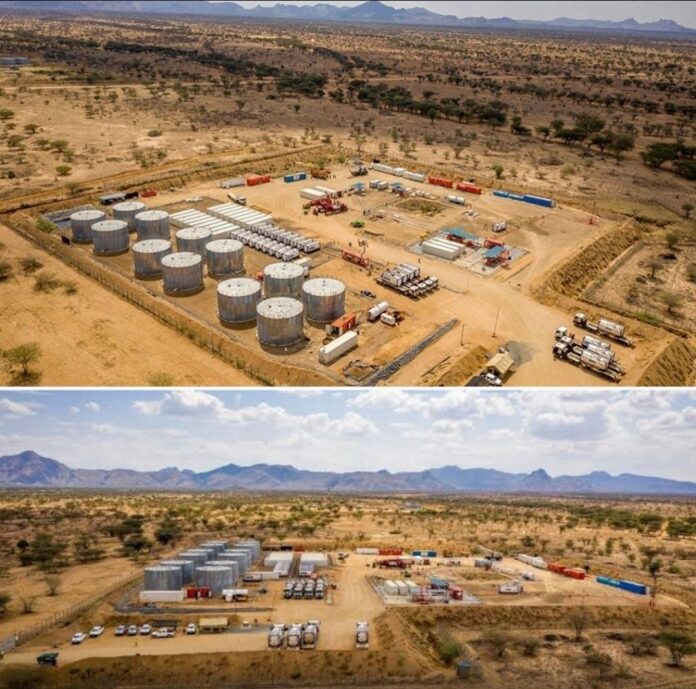
Kenya is poised to cross a historic economic threshold this month as drilling operations officially commence for its first commercial oil development well in Turkana County. The highly anticipated move signals the country’s transition from a decade-long exploration phase into active petroleum production, with the government aiming to position Kenya as a recognized crude oil exporter on the global stage.
The breakthrough follows the formal approval of the Field Development Plan (FDP), which was recently signed by the Ministry of Energy and Petroleum. This regulatory milestone, along with Parliament’s ratification of the commercial framework last year, cleared the long-standing legal and administrative hurdles that had previously stalled the project. According to official government schedules, extraction teams are targeting December 2026 for the first output of commercial crude.
The initial phase of the development focuses strictly on the South Lokichar Basin. Project projections indicate that production will kick off at an initial stream of 20,000 barrels per day (bpd), dedicated primarily for international export markets. To mitigate heavy upfront financial risks, the government and its partners are deploying a phased extraction model. This strategy allows early revenues generated from the initial 20,000 bpd to fund subsequent expansion phases. Output is expected to remain at this baseline for several years before scaling up significantly to 50,000 barrels per day by 2031.
The revival of the upstream petroleum project comes on the heels of a major corporate shakeup. Local player Gulf Energy recently acquired the oil field interests from British explorer Tullow Oil for $120 million. Tullow, along with other international partners, exited the venture citing severe financing challenges compounded by a shifting global investment climate focused on cleaner energy. Gulf Energy’s capital injection has effectively breathed new life into the asset, which geological assessments indicate holds an estimated 2.85 billion barrels of oil, with 429 million barrels deemed legally and technically recoverable.
Despite the optimism, the Turkana oil venture presents unique geographical and physical challenges. Because Kenya lacks a functional domestic refinery—the defunct Changamwe refinery in Mombasa ceased operations in 2013—the state must rely entirely on exporting raw crude. This means the oil must initially move by road to the coast. While a regional refinery in Tanga, Tanzania, remains under discussion to process East African crude in the future, trucking remains the only immediate option.
Furthermore, Turkana crude has a remarkably high paraffin content, giving it a thick, waxy consistency. To prevent the oil from solidifying during transit and storage, engineering teams must install specialized multiphase pumps, insulated storage tanks, and heated pipeline systems at the central processing facility.
The current production strategy builds on lessons learned from the Early Oil Pilot Scheme (EOPS), which ran between 2018 and 2022. While the pilot successfully proved global demand by exporting over 414,000 barrels of Turkana crude, it faced severe disruptions from extreme weather that washed out local road infrastructure. To prevent a recurrence, the state is actively upgrading roads connecting the well sites to major transit corridors.
To safeguard the multi-billion-shilling infrastructure and the workforce, the government has launched targeted security operations across Turkana East and Turkana South. Additionally, because drilling and maintaining reservoir pressure requires massive volumes of water, the Kenya Defence Forces (KDF) have been deployed to secure water transport from the Turkwel Dam—a move intended to balance industrial needs with the water scarcity concerns of local host communities.
Energy and Petroleum Cabinet Secretary Opiyo Wandayi clarified that while local infrastructure will see heavy investment, the project will not result in an immediate drop in local fuel prices. Instead, the economic returns for Kenyans will materialize through direct government revenues, job creation, and a substantial boost to the country’s foreign exchange reserves.