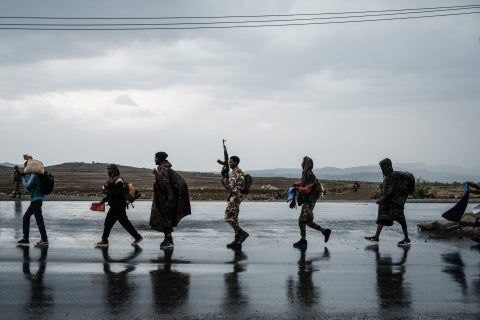
Regional authorities in Ethiopia’s northern Tigray region have been systematically abducting and unlawfully recruiting civilians, including children as young as 15, to replenish their military forces. According to an extensive investigation published July 6,2026 by Human Rights Watch (HRW), the forced conscription drive has been actively operating since at least April 2026. The aggressive campaign relies on arbitrary street roundups, nighttime house-to-house searches, and targeted raids at key economic hubs. The severe measures have effectively cast a deep blanket of fear across communities throughout the war-weary region.
The sudden and intense escalation in military mobilization follows months of rapidly deteriorating relations and heightened tensions between Ethiopia’s federal government and Tigray’s dominant political faction, the.
Tigray People’s Liberation Front (TPLF). The two entities previously engaged in a devastating, two-year-long armed conflict between 2020 and 2022 that resulted in widespread atrocities. While a fragile truce was successfully brokered and signed in November 2022, the recent mobilization activities raise critical concerns. Before launching the physical crackdowns in April, local Tigrayan officials spent months using less aggressive tactics, including public town halls, formal letters, and phone calls, to pressure former Tigray Defense Forces (TDF) combatants to voluntarily re-enlist.
By early June 2026, the TPLF shifted strategies completely by issuing a formal, sweeping proclamation that legally compelled military service across the region. Though a party spokesperson vehemently denied HRW’s findings in a recent media interview, asserting that those defending Tigray are doing so entirely of their own free will, field evidence strongly contradicts those claims.
Human Rights Watch documented that the campaign drastically intensified in late April with coordinated, mass roundups. Local authorities reportedly compiled detailed rosters of former fighters and deployed neighborhood informants to systematically track down and seize potential candidates from public spaces.
Witnesses and survivors who spoke to investigators painted a harrowing picture of the ongoing tactics. In Tigray’s Northwestern Zone, an escaped former fighter recalled armed men in uniform storming his house at night and detaining him alongside 17 others at a local police station. Shockingly, he observed that four or five of the individuals held with him were young teenagers, aged roughly 16 or 17.
The sweep did not stop at former military personnel; it quickly expanded into an indiscriminate roundup of the general civilian population, sweeping up daily laborers, farmers, and automated rickshaw drivers alike. In the town of Adi Gudem, local forces even abducted young water-cart operators who were actively distributing essential water to the community amidst a major utility shortage. One cart owner who attempted to escape the net was beaten so severely by militias that he fell completely unconscious.
A particularly aggressive operation took place on May 25 at an artisanal gold-mining site near Kola Tembien, located in the Central Tigray Zone. After ordering the miners to halt operations a few days prior under the guise of an investment land dispute, dozens of police and TDF forces returned to trap the workers.
Witnesses described forces beating the miners before segregating them based on their home administrative districts. One miner recounted being transferred to an unfinished building where he was held for eight hours alongside 60 other men and boys. A local district leader then arrived to flatly inform them they were being integrated into the TDF. When the captives collectively opposed the directive, armed guards forced them onto transport trucks at gunpoint.
Driven at dangerous speeds, one desperate captive attempted to jump from the moving vehicle, hitting the pavement motionless as the remaining captives watched.
Once captured, the newly conscripted recruits are temporarily held inside local government offices, public schools, or local jails before being transferred to regional military training camps located primarily in Southern and Northwestern Tigray.
The human toll has forced a massive disruption to normal civil life, compelling vulnerable men and boys to sleep outdoors in fields to avoid nighttime home raids, or to flee the region entirely. In a punitive turn, local Tigrayan authorities have begun enforcing collective punishment against families whose sons evade the draft. In the Northwestern Zone, local officials held a group of parents for ten days straight without food or water, threatening to detain them indefinitely until they agreed to surrender their children. Another 32-year-old laborer recounted fleeing to the capital city of Addis Ababa on his father’s advice, forced to leave his pregnant wife behind because he lacked the funds to transport her safely.
Human Rights Watch emphasized that these actions directly violate multiple frameworks of international humanitarian law. Under Common Article 3 of the 1949 Geneva Conventions, forced recruitment by non-state armed groups is strictly outlawed as an explicit outrage upon personal dignity.
Furthermore, the recruitment or operational use of children under the age of 18 in hostilities—whether forced or voluntary—presents a severe violation of human rights, while the conscription of children under the age of 15 constitutes a distinct war crime. Because Ethiopia ratified the Optional Protocol on the involvement of children in armed conflict in 2014, the region remains bound to these global standards. Legal experts also noted that the TPLF’s official proclamation mandating collective family punishment constitutes a blatant breach of international statutes.
In light of these findings, Human Rights Watch has urged international stakeholders—specifically the African Union, the United States, the European Union, and regional mediators like Kenya and South Africa—to apply coordinated diplomatic pressure on the TDF leadership.
The organization demands an immediate halt to the forced conscription practices, the unconditional release of all children and unlawfully detained civilians, and the swift withdrawal of the punitive military proclamation. Furthermore, HRW calls for independent international monitors, including the United Nations Office of the High Commissioner for Human Rights, to launch immediate on-the-ground investigations.