Ethiopia’s ambitious macroeconomic trajectory has hit a critical global bottleneck. According to the June 2026 Global Economic Prospects report released by the World Bank, the country’s economic growth projection for 2026 faces an explicit 0.8 percentage point drag. This downward revision is the direct result of intensifying geopolitical conflicts in the Middle East, which have fractured global supply chains and sent severe commodity shocks rippling across East Africa.
Before the outbreak of the conflict, Ethiopia’s domestic economy was on exceptionally firm footing, supported by robust agricultural output and sweeping structural overhauls. However, the World Bank’s latest assessment reveals that the negative spillover effects from the Middle East are now actively threatening to outweigh some of these domestic growth drivers, forcing a critical recalibration of the nation’s near-term economic outlook.
The primary transmission channel of this economic distress into Ethiopia is the global commodity market. Non-oil-exporting, commodity-importing nations are bearing the heaviest burden of the current geopolitical environment.
The report details several severe pressures currently filtering into the domestic market, starting with the energy crunch. Global Brent crude oil prices are projected to average $94 per barrel in 2026, representing a staggering 36 percent increase over 2025 levels and more than 50 percent higher than original January projections. For Ethiopia, this translates into a massive, unbudgeted surge in the national import bill.
Furthermore, the conflict has severely disrupted the global fertilizer trade. Driven by a 30 percent spike in European natural gas prices—a primary input for nitrogen fertilizers—the cost of agricultural inputs has skyrocketed. For Ethiopia’s agrarian-dependent economy, these inflated input costs create an immediate threat to crop yields and food security. Compounding this, logistical bottlenecks have tightened.
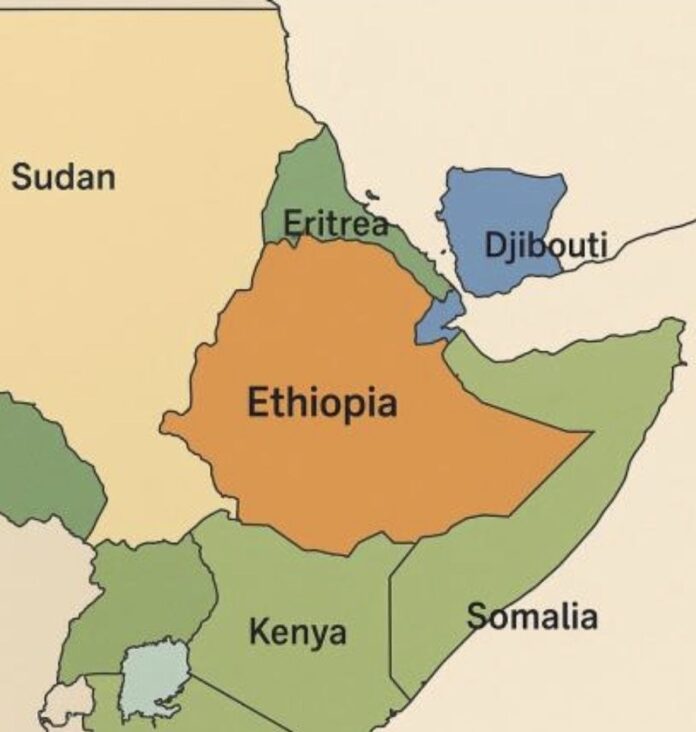
The World Bank’s baseline assumes that maritime shipping through vital trade corridors, particularly the Strait of Hormuz, will remain severely disrupted through at least July 2026, halting and delaying trade volumes while driving up freight and transport costs across the Horn of Africa.
The immediate domestic consequence of these imported commodity shocks is a sharp resurgence of inflationary pressures. High-frequency economic indicators from early 2026 indicate that Ethiopia’s previously successful disinflation process has stalled. Driven by the rising costs of imported fuel, fertilizer, and logistics, the annual headline consumer inflation rate experienced a concerning re-acceleration in April 2026.
This spike in living costs has left the government navigating a delicate fiscal tightrope. To shield vulnerable households from the immediate sting of soaring prices, authorities in Addis Ababa have been forced to implement expanded or temporary fuel subsidies. However, the World Bank warns that these interventions come at a steep price. With domestic fiscal resources already tightly constrained, funding these expanded subsidies is expected to widen public deficits and increase the necessity of public borrowing, reducing the capital available for long-term development projects.
Despite the 0.8 percentage point challenge imposed by these severe external headwinds, the Global Economic Prospects report emphasizes that Ethiopia remains a remarkably resilient outlier in the Sub-Saharan Africa region. While the global crisis has shaved a fraction off its potential, the country’s real GDP growth is still projected to reach an enviable 8.0 percent in 2026, before tracking at 6.9 percent in 2027 and rebounding to 8.4 percent by 2028.
This foundational resilience is being sustained by the government’s aggressive commitment to domestic policy overhauls. The World Bank notes that Ethiopia’s growth is heavily insulated by bold, ongoing reforms in monetary policy and the financial sector.
Foremost among these domestic policies is the country’s historic shift toward exchange-rate liberalization. By allowing the currency to better reflect market realities, Ethiopia is successfully correcting long-standing structural distortions, improving foreign exchange liquidity, and boosting investor confidence.
Additionally, parallel improvements in public financial management and the implementation of business-friendly measures are helping to stimulate private sector investment. Ultimately, while the Middle East conflict has successfully forced a 0.8 percentage point drag on Ethiopia’s immediate growth, the sheer momentum of its domestic financial reforms is keeping the nation positioned as an essential engine of economic growth across Africa through the end of the decade.