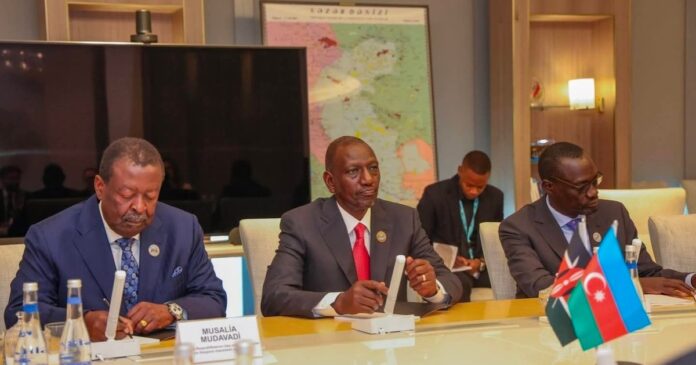
Kenyan President William Ruto held fruitful talks with Azerbaijani President Ilham Aliyev and top executives from the State Oil Company of the Republic of Azerbaijan (SOCAR) during the World Urban Forum in Baku. The meeting aimed to strengthen cooperation between the two nations in the areas of oil, natural gas, renewable energy, and infrastructure development.
In a post on his X (formerly Twitter) account, President Ruto stated, “Kenya is strengthening cooperation with Azerbaijan, through the State Oil Company of the Republic of Azerbaijan (SOCAR), in the energy sector, particularly in oil and gas, and renewable energy.” He further explained that this effort is part of Kenya’s drive to attract strategic investment to expand its energy generation capacity.
Most notably, the discussions focused on the possibility of SOCAR investing in the proposed East African oil refinery project, which is designed to benefit the entire East African region. This reinforces Nairobi’s ambition to position itself as a future regional energy and refining hub.
Kenya is actively broadening its search for investment opportunities to bring this regional refinery project to fruition. A central focus of the discussions was Azerbaijan’s potential involvement in the refinery project, which Nairobi hopes will significantly boost fuel security and refining capacity across East Africa.
This renewed outreach comes shortly after Kenya engaged with Nigerian billionaire Aliko Dangote over possible collaboration tied to refinery development and fuel supply infrastructure in the region. However, Kenya’s recent engagement with SOCAR suggests that Nairobi is keeping all strategic options open as it evaluates potential investors and refinery models.
Currently, there is strong competition in the region, as other East African countries—including Tanzania and Uganda—are also pursuing similar ambitions to expand their domestic refining capacity.
Economic and political analysts note that Azerbaijan presents an attractive alternative for Kenya because of SOCAR’s extensive, state-backed experience in refining, pipeline infrastructure, and energy trading across Eurasia and the Caspian region.
Unlike private-sector-led refinery models, Azerbaijan’s approach could offer Kenya deeper government-to-government (G2G) cooperation, financing flexibility, and the technical expertise required to build integrated energy systems. Furthermore, Kenya aims to leverage SOCAR’s expertise in gas exploration and renewable energy to support its goal of generating 10,000MW of electricity within the next decade.
Kenya’s renewed urgency to secure refinery partnerships comes at a time when the country is facing mounting domestic pressure and public protests over rising fuel costs. These high costs continue to weigh heavily on transport, food prices, and broader inflation.