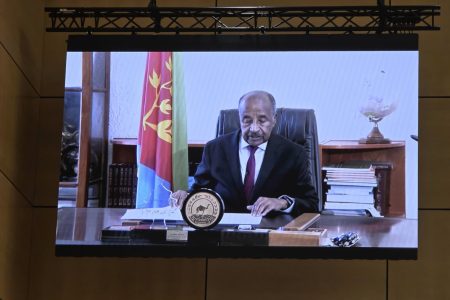
Eritrean Minister of Foreign Affairs, Osman Saleh, addressed a high-level conference in Geneva this week, calling for an immediate end to the “normalization and expansion” of unilateral coercive measures.
Speaking at the Conference on Humanitarian Action, Remedy and Responsibility in Unilateral Sanctions Environment, Minister Saleh argued that while international sanctions are often framed as surgical tools for diplomacy, their real-world application has resulted in a “systemic financial exclusion” that stifles the development of sovereign nations and targets the most vulnerable sectors of society.
The Minister’s address provided a sobering historical context, noting that Eritrea’s struggle with international sanctions is not a new phenomenon. Having navigated United Nations Security Council sanctions from 2009 to 2018—measures Eritrea maintains were based on “unsubstantiated claims”—the nation now finds itself entangled in a more complex web of unilateral measures imposed by influential state actors.
He emphasized that the residual effects of past sanctions persist, but they have been supplanted and deepened by an expanding architecture of unilateral measures that operate outside the framework of multilateral legitimacy.
A central theme of the Minister’s testimony was the phenomenon of “over-compliance” among global financial institutions. He described a climate of fear where banks and regulatory bodies, terrified of secondary sanctions and reputational damage from Western powers, go far beyond the legal requirements of sanctions.
This “culture of caution” has effectively locked Eritrea out of the routine global financial transactions necessary for a modern economy. Saleh noted that even when transactions are legally permissible, they are frequently delayed, denied, or subjected to such extreme scrutiny that they become practically impossible to execute, creating a de facto blockade that bypasses formal international law.
Minister Saleh pointed to a “central paradox” in the Western diplomatic playbook: the use of sanctions to promote human rights while those very measures actively undermine the right to health, food, and development. In the healthcare sector, the procurement of life-saving medicines and diagnostic equipment is routinely impeded by disrupted financial channels and supplier hesitancy.
Similarly, in agriculture, constraints on financing have limited the import of essential machinery and inputs, directly threatening food security and the livelihoods of rural populations. These are not just economic statistics; they represent systemic impediments to the realization of the Sustainable Development Goals.
The Minister concluded his statement by calling for a “principled and collective response” from the international community, arguing that the current system has “diffused responsibility,” allowing state and non-state actors to hide behind opaque compliance systems without being held accountable for the humanitarian fallout.