In a decisive step to protect the backbone of Uganda’s rural economy, a UGX 3.7 billion (€850,000) public-private partnership project has been launched to completely overhaul the country’s coffee planting material system. This three-year initiative aims to solve the productivity challenges that stand in the way of Uganda’s ambitious goal to produce 20 million bags of coffee annually by 2030.
Led by the United Nations Industrial Development Organization (UNIDO) and World Coffee Research (WCR), the program brings together global coffee giants such as the Lavazza Foundation, JDE Peet’s, and The J.M. Smucker Company, demonstrating international confidence in the quality and potential of Ugandan coffee.
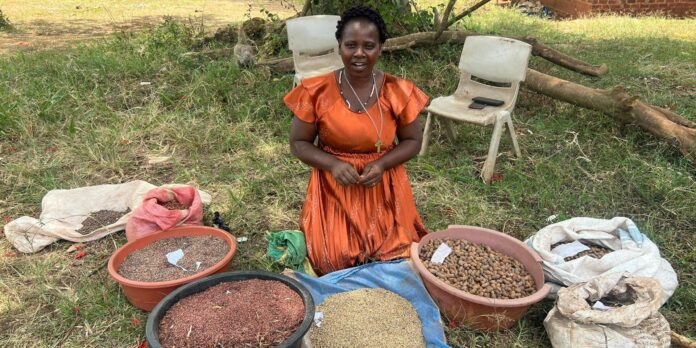
Although coffee generated $2.4 billion in foreign exchange earnings in 2025, the sector continues to be tested by stagnating productivity. Experts attribute this to aging coffee trees, droughts caused by climate change, and successive outbreaks of crop diseases like Coffee Wilt Disease (CWD). Currently, approximately 1.8 million smallholder households depend on coffee for their livelihoods; however, most of these farmers have been forced to use seedlings that are of unverified quality and cannot withstand the pressures of a changing climate
This initiative focuses on three key pillars to transition the sector from subsistence farming to high-level commercial production. First, it prioritizes infrastructure development by establishing new nursery sites across Northern, Central, and Western Uganda, which are expected to produce 460,000 improved coffee trees annually.
Second, the program emphasizes seed quality assurance through the genotyping of over 5,000 coffee varieties, ensuring that the seedlings distributed to farmers are high-yielding and disease-resistant. Finally, there is a dedicated focus on climate resilience, specifically developing and distributing drought-tolerant varieties suited for the arid conditions in the northern part of the country.
Beyond technical and scientific advancements, this project serves as a beacon for rural prosperity by offering significant financial benefits to farmers. Research cited in the program indicates that adopting these improved, disease-resistant varieties can more than double a single farm’s income. As a project spokesperson noted,
“This is about more than just numbers; it’s about trust. When a farmer plants a tree, they are placing years of their hard labor into the ground. This initiative provides a guarantee that their investment will not fail due to the first drought or disease.”