
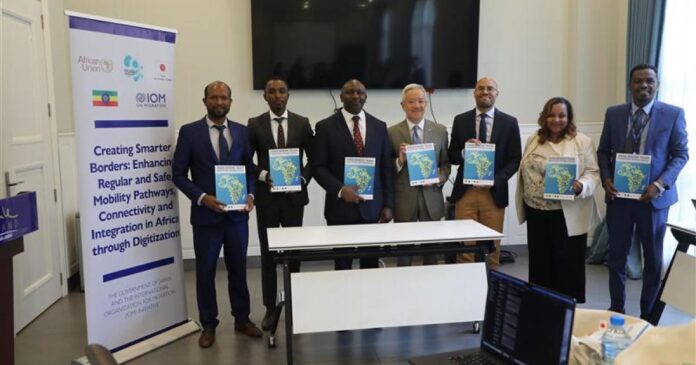
The Ministry of Trade and Regional Integration (MoTRI), in partnership with the International Organization for Migration (IOM) and the Government of Japan, officially launched a comprehensive Cross-Border Trade Facilitation Training Manual this week.
This manual is designed to serve as a harmonized blueprint for border officials, customs agents, and traders, specifically addressing the long-standing challenges of informal trade and fragmented border management. By providing a standardized framework, the initiative seeks to streamline the movement of goods and people while ensuring that security, public health, and human rights remain at the forefront of Ethiopia’s border operations.
For decades, Ethiopia’s border regions have relied on informal trade as a primary lifeline for local communities. While essential for food security and livelihoods, these uncoordinated practices often led to significant revenue loss for the state and created vulnerabilities regarding public health and safety.
The new manual introduces a multi-sectoral approach, integrating modules on customs and immigration procedures alongside often-overlooked areas such as gender mainstreaming, disability inclusion, and protection principles.
During the high-level launch event in Addis Ababa, Tsegaw Cherinet, Advisor to the State Minister for Trade Integration and Export Promotion, emphasized that this achievement is the result of a collaborative partnership and a shared vision for enhancing economic ties with neighboring countries.
The launch aligns with the broader goals of the African Continental Free Trade Area (AfCFTA) and the African Union’s Agenda 2063. Sabelo Mbokazi (PhD) of the African Union Commission noted that harmonized border governance is a vital pillar for advancing continental integration. By simplifying trade systems, Ethiopia is positioning itself as a leader in facilitating the free movement of persons and boosting intra-African trade.
Sekiguchi Noboru, Ambassador of Japan to the African Union, highlighted the human element of the initiative, stating that cross-border trade is far more than the movement of goods; it is a source of employment and a driver of food security and regional stability.
Beyond trade logistics, the manual provides a technical reference for the Ethiopian Federal Police, the Immigration and Citizenship Service, and the Ethiopian Public Health Institute. It aims to reduce the protection concerns often associated with informal border crossings, ensuring that vulnerable groups are treated with dignity and that health protocols are strictly maintained.
Sascha Nlabu, IOM Ethiopia’s Head of Programmes, remarked that this marks a crucial step toward institutionalizing inclusive and secure trade. The manual will now be integrated into training programs at national and regional levels, ensuring that border officials are equipped with the skills necessary to handle the complexities of 21st-century migration and commerce.
As Ethiopia continues its journey toward economic liberalization and capital market development, the formalization of its borders represents a critical foundation for sustainable growth and peaceful coexistence within the Horn of Africa.