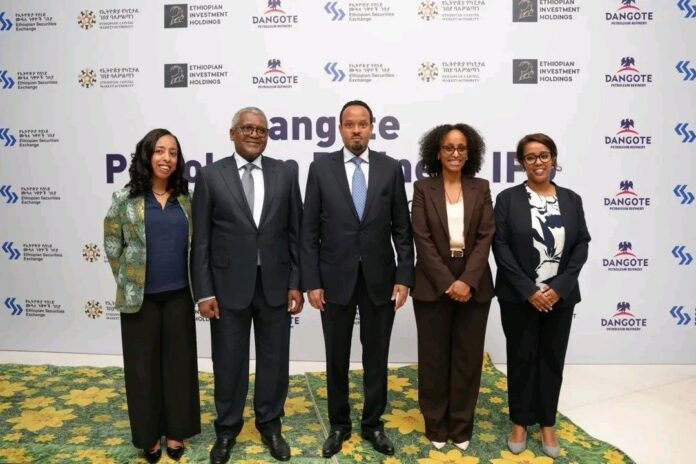
Ethiopian investors hoping to buy shares in Dangote Oil Refinery Company must meet a steep wealth threshold, with the Ethiopian Capital Market Authority (ECMA) restricting the offering to a small circle of qualified investors and explicitly excluding retail buyers.
According to ECMA’s, individual investors must have a minimum net worth of 10 million birr, excluding the value of one vehicle and one primary residential property. Participation is capped at 100 qualified investors unless the regulator grants prior approval for a higher number. Each share is priced at approximately 74.9 birr, and the offering remains open until October 27, 2026.
The restrictive Ethiopian window forms part of a far larger capital-raising exercise. Dangote Refinery is seeking approximately $1.6 billion through an initial public offering of 4.1 billion new shares. The proceeds will finance an expansion programme aimed at doubling crude oil processing capacity from about 700,000 barrels per day to 1.4 million barrels per day by 2029.
Located in Nigeria’s Lekki Free Zone, the refinery is Africa’s largest oil-processing facility. Built by Africa’s richest man, Aliko Dangote, at a cost of roughly $20 billion, it began operations in early 2024 and has since reshaped refined-product trade flows across West Africa and beyond.
Figures disclosed in the IPO documents show Dangote Refinery generated approximately $13.6 billion in revenue and recorded a profit of around $1.78 billion during the first half of 2026 — a dramatic turnaround attributed partly to disruptions in European fuel supply.
ECMA’s approval comes with stringent conditions. Interested investors must conduct all transactions through legally licensed securities trading entities, which are required to verify and document each buyer’s eligibility. Marketing materials must state clearly that the securities are not being offered to the Ethiopian public, and mass-marketing campaigns are prohibited.
The regulator also cautioned that its approval should not be interpreted as an endorsement of the refinery or the investment’s merits. Prospective investors remain responsible for reviewing the offering documents and assessing risks, including volatility in international crude oil prices, foreign exchange movements, regulatory and policy changes, competition in the petroleum sector, and possible delays in executing the expansion programme.
The IPO has been positioned as a pan-African opportunity, and in Nigeria retail investors can participate with as little as 10 shares, worth roughly 5,250 naira. Kenya’s regulator has approved access through depository receipts, opening the door to ordinary savers.
But other markets have taken a narrower approach. Uganda, like Ethiopia, has limited participation to professional or high-net-worth investors. Ethiopia’s own capital market is still in its infancy — the Ethiopian Securities Exchange (ESX) launched in January 2025 and had only four listed companies as of mid-2026 — leaving regulators cautious about exposing the public to a large foreign industrial offering.