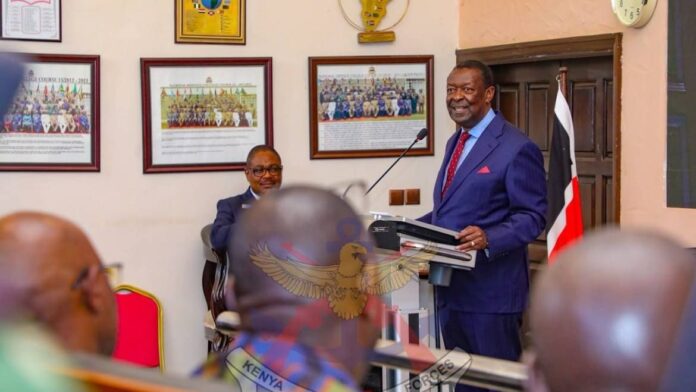
Kenya has reaffirmed its strategic commitment to fostering peace and stability across the Horn of Africa while navigating an increasingly volatile global security landscape. The nation’s diplomatic posture was outlined by the Prime Cabinet Secretary and Cabinet Secretary for Foreign and Diaspora Affairs, Dr. Musalia Mudavadi, during a high-level address at the National Defence College (NDC) in Nairobi.
Delivering a “Lecture of Opportunity” to participants of Course No. 29 for the 2026/2027 academic year, Dr. Mudavadi provided an analysis of contemporary geopolitical shifts, regional security challenges, and the cornerstone principles driving Kenya’s strategic foreign policy.
Addressing senior military officers, government officials, and allied international participants, Dr. Mudavadi underscored that the international security architecture is undergoing profound transformation. He pointed to escalating major-power competition, rapid technological advancements, shifting geopolitical blocs, and persistent armed conflicts as factors that are reshaping international relations and testing multilateral institutions.
Turning attention to the continent, the Prime Cabinet Secretary cautioned that Africa’s persistent security deficits, governance gaps, and socioeconomic inequalities continue to undermine political stability and long-term economic development. He placed particular emphasis on the Horn of Africa, identifying the devastating internal conflict in Sudan and the resilient threat posed by the terrorist network Al-Shabaab as major regional flashpoints.
According to Dr. Mudavadi, mitigating these threats requires sustained multilateral diplomacy, heightened intelligence cooperation, and unified regional responses through bodies such as the Intergovernmental Authority on Development (IGAD) and the East African Community (EAC).
Central to Dr. Mudavadi’s lecture was the revised Foreign Policy framework, updated in December 2024, which anchors Kenya’s strategic diplomacy around eight key pillars. These pillars include peace and security diplomacy, economic and commercial diplomacy, digital diplomacy, diaspora engagement, and global governance.
He stressed that effective national defense cannot exist in isolation from robust diplomatic engagement. “For Kenya, foreign policy is not simply an instrument for managing relations between states,” Dr. Mudavadi stated. “It is a means of protecting our sovereignty, creating opportunities for our people, safeguarding our development ambitions, and contributing to a more peaceful and secure world.”
The engagement coincided with Kenya Defence Forces (KDF) Day, offering a timely opportunity to reflect on the sacrifices of military personnel and the essential synergy between defense capabilities and diplomatic negotiation in protecting territorial integrity and regional security.
The College Commandant, Lieutenant General Juma Mwinyikai, welcomed the Prime Cabinet Secretary, noting that the session provided strategic clarity for senior leaders responsible for formulating defense policy and navigating complex global realities.