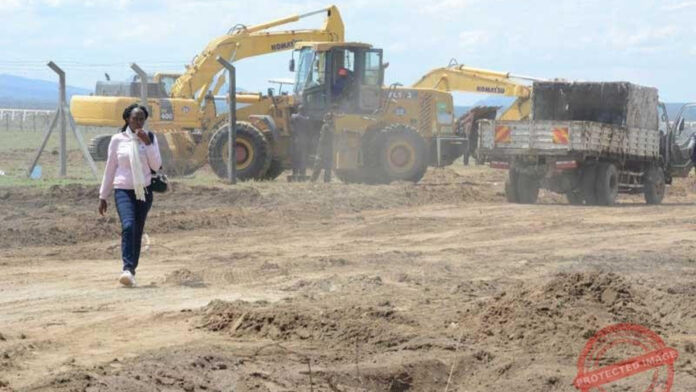
South Sudan has officially broken ground on a dedicated dry port facility within the Naivasha Special Economic Zone in Nakuru County, Kenya. The groundbreaking ceremony marks South Sudan as the first landlocked East African nation to commence active construction on land allocated by Kenya near the Standard Gauge Railway (SGR) freight terminal.
The 10-hectare facility is designed to serve as an inland logistics hub where South Sudan-bound freight arriving at the Port of Mombasa can be transferred directly by rail to Naivasha for customs clearance, cargo tracking, and storage. By bypassing extended delays at the coast, the project aims to reduce container demurrage fees, shorten cargo turnaround times along the Northern Corridor, and protect South Sudanese importers from systemic transport bottlenecks.
Speaking during the launching ceremony, South Sudan’s Ambassador to Kenya, Simon Juach Deng, emphasized that the dedicated depot will significantly enhance cargo tracking and operational coordination between authorities in Juba and Nairobi.
“What this will do is going to help us ease the congestion at the Mombasa port where containers destined for South Sudan are held,” Deng stated. “Most of them will be shipped to Naivasha, where we can manage tracking them easily and protect our traders from costly operational delays.”
Representing Kenya’s Cabinet Secretary for Transport, Public Service Cabinet Secretary Geoffrey Ruku highlighted the broader regional benefits of the logistics hub. He noted that South Sudan’s pioneering move sets a precedent for neighboring landlocked economies—including Uganda, Rwanda, and Burundi—which have also received land allocations in the Naivasha economic belt.
“The establishment of these logistics facilities will boost trade and turn Naivasha into a major trade gateway for East and Central Africa,” Ruku said. “With South Sudan taking the lead, this investment will accelerate cargo evacuation, boost intra-regional commerce, and significantly improve efficiency along the Northern Corridor.”
The commencement of civil works follows high-level bilateral discussions in Nairobi between South Sudanese President Salva Kiir and Kenyan President William Ruto. During those meetings, President Kiir raised serious concerns over exorbitant port tariffs, multi-agency clearance layers, and transit surcharges that directly contribute to high commodity prices for South Sudanese consumers.
South Sudan’s Undersecretary in the Ministry of Transport, Paul Dhel Gum, characterized the Naivasha facility as a strategic gateway that will provide long-term relief to the trade community. He also confirmed that South Sudan is pursuing additional logistics parcels near the border entry points of Malaba and Busia, as well as near Mombasa, to create an integrated transit corridor stretching to Juba.
Under the new operational workflow, sea cargo bound for Juba will be loaded onto SGR freight trains immediately upon discharge in Mombasa and hauled to Naivasha. Clearing agents and customs officers from the South Sudan Revenue Authority will process manifests on-site before truck convoys haul the freight across the border, cutting transit times by several days.
Trade analysts observe that while the dry port provides the necessary physical infrastructure, its ultimate success in lowering consumer prices in Juba will depend on operational efficiency, seamless railway logistics, and ensuring that transport savings are effectively passed down through the supply chain.