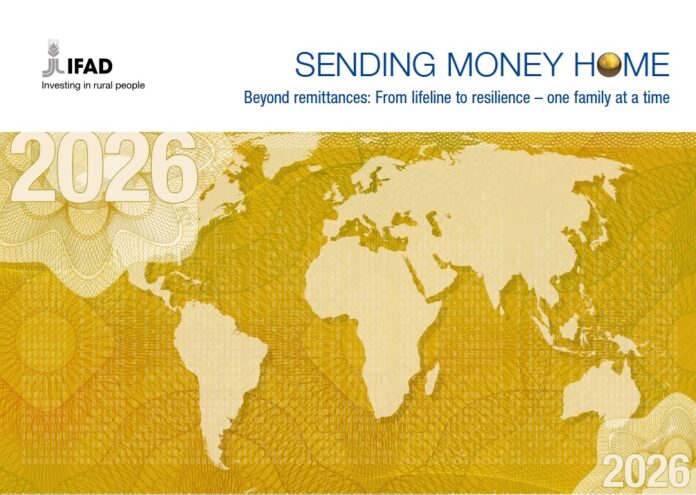
Family remittances sent by African migrants to their home countries have reached an estimated $124.2 billion annually, cementing these private financial transfers as one of the continent’s largest and most dependable lifelines for rural households, according to a report by the International Fund for Agricultural Development (IFAD).
The flagship report, titled “Sending Money Home 2026,” documents a decade of accelerating growth across remittance corridors, noting that inflows to Africa expanded by 86 percent between 2016 and 2025—far outpacing the continent’s population growth and the increase in overall emigration.
The regional landscape has seen significant shifts in recipient rankings over the past decade. Egypt has emerged as Africa’s largest remittance market, receiving $41.5 billion in 2025, followed by Nigeria at $22.8 billion and Morocco at $13.7 billion. Ethiopia ($7.1 billion) and Kenya ($5.0 billion) entered the continent’s top five recipient markets, replacing Ghana and Algeria. Together, these five nations accounted for approximately 73 percent of total remittance inflows to Africa.
However, the report emphasizes that economic reliance on remittances is highest among smaller economies. Remittances represent 22 percent of gross domestic product (GDP) in The Gambia and 21 percent in Liberia, Comoros, and Lesotho, followed by Cabo Verde at 12 percent and Senegal at 11 percent. In these countries, diaspora transfers serve as a critical cushion for household consumption and foreign exchange reserves.
Crucially, roughly 34 percent of Africa’s remittance inflows—equivalent to nearly $42 billion—flow directly to rural communities. In Eastern Africa, the rural share reaches 51 percent, providing vital support where access to formal banking infrastructure and social safety nets remains limited.
Despite rapid growth in transaction volumes, Africa remains the most expensive region in the world to send money to. The average non-bank cost of sending $200 to Africa stood at 7.2 percent in late 2025, down from 9.0 percent in 2016, but still well above the Sustainable Development Goal (SDG 10.c) target of less than 3 percent.
Transfer costs vary sharply across different parts of the continent. Western Africa recorded the lowest average transfer cost at 4.9 percent, aided by expanding mobile money integration and fixed euro–CFA franc exchange mechanisms. Eastern Africa saw costs drop from 9.7 percent to 7.2 percent over the decade, while Southern Africa remains the most expensive subregion globally, with transfer costs averaging 10.4 percent. In contrast, Central and Northern Africa experienced slight cost increases, averaging 9.7 percent and 7.3 percent, respectively.
IFAD notes that fully digital remittance services—where transactions are sent and received electronically without cash—cut the average cost to 4.59 percent, compared to 7.30 percent for cash-based services. However, fully digital transfers still represent only about a third of all sampled corridors, as many rural recipients continue to rely on physical cash payout agents.
With more than half of African migrants living and working within the continent, the report highlights the strategic importance of linking cross-border payment platforms. Initiatives such as the Pan-African Payment and Settlement System (PAPSS) and regional instant payment networks are seen as crucial to reducing reliance on expensive correspondent banking networks and bringing intra-African transfer fees down.
Beyond covering daily household necessities like food, education, and healthcare, diaspora funds increasingly function as informal insurance against economic shocks and severe climate disruptions. In countries like Senegal, Mali, and Kenya, remittance-receiving rural households have demonstrated significantly higher rates of savings and greater adoption of climate-smart farming techniques, drought-resistant crops, and solar irrigation.
IFAD urges policymakers and financial institutions to integrate remittance flows into broader national financial inclusion strategies, calling for the bundling of diaspora transfers with accessible savings, micro-insurance, and credit products to help African families build long-term economic resilience.