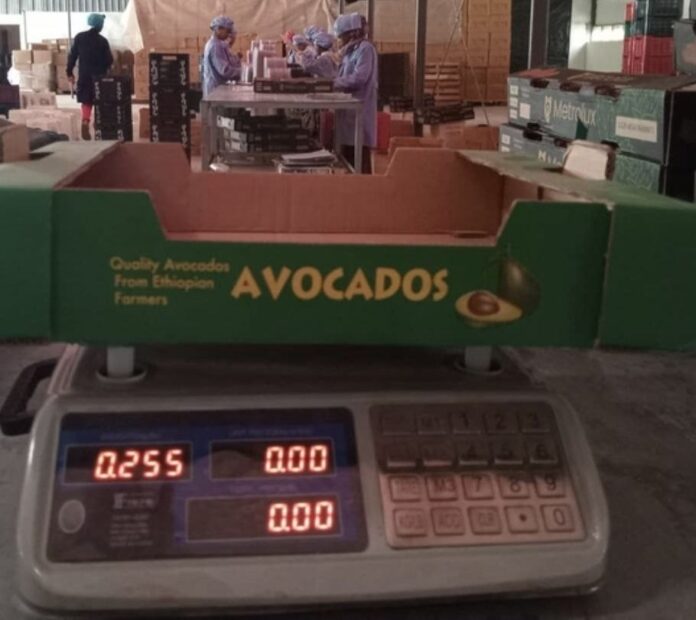
The Ministry of Agriculture’s ongoing initiative to standardize packaging weight ratios for air-freighted horticultural exports aims to improve export valuation accuracy and ensure consistency in foreign currency repatriation calculations, officials revealed.
According to Mekonnen Solomon, an agricultural economist at the Ministry of Agriculture, this new approach was prompted by a long-standing challenge in verifying the actual net weight of export products. While Ethiopian Airlines calculates freight charges using gross weight or volumetric dimensions, customs authorities require the precise net weight of the produce for trade valuation. In practice, due to limited independent weighing infrastructure for highly perishable exports, customs has heavily relied on self-declared data provided by the exporters themselves.
“This reliance on self-declared data is not merely an administrative oversight; it is a significant fiscal vulnerability,” Mekonnen explains. “Any inaccuracy in net weight directly affects the accuracy of foreign currency repatriation calculations that should be returning to the country.”
The policy is critical because foreign currency repatriation requirements are calculated based on fixed floor prices applied to the net weight of the exported produce. Consequently, the weight of the packaging material directly influences both the officially recorded export value and the total foreign exchange earnings generated for the national economy. Excessive or oversized packaging reduces the proportion of saleable product within a single shipment, lowering net export value. Conversely, utilizing lightweight and efficient packaging drastically improves repatriation performance while simultaneously reducing airfreight logistics costs.
Recognizing this economic link, the Ministry of Agriculture introduced packaging weight standards in 2018 for fruits, vegetables, herbs, and vegetable seeds exported by air. The policy was developed as part of broader strategic efforts to increase overall horticultural export earnings and elevate the country’s international market competitiveness.
Field assessments conducted at various production sites, including strawberry farms in Holeta, revealed significant variation in packaging intensity across different product categories. For instance, packaging material ratios for avocados and grapes averaged approximately 18%, while strawberries reached around 30%. Herbs showed considerably higher ratios, approaching nearly 70% in certain export formats due to the intensive protective configurations required to preserve the product’s quality.
These field findings directly informed the establishment of specific produce-to-packaging benchmark ratios. Under the regulations, avocados and grapes are assigned an 80:20 ratio, berry varieties are set at 65:35, and category-specific standards have been tailored for herbs, vegetables, and seeds. According to Mekonnen, these benchmarks encourage exporters to adopt lightweight, high-strength materials and optimize packaging designs without compromising the physical integrity of the perishable goods.
The macroeconomist also highlighted the severe limitations of current manual customs verification practices, noting that slow procedures can delay highly perishable shipments and increase operational risks for exporters. “In both developing and advanced economies, there is growing reliance on AI-powered scanners, digital counters, and automated classification systems,” he says, adding that the slow adoption of these digital technologies continues to perpetuate trade inefficiencies. He calls for systematic collaboration among government agencies, standards institutions, and private innovators to deploy automated systems capable of accurately measuring gross and net weights without disrupting regular export flows.
Another structural concern is the widespread use of duty-free imported packaging materials. While these fiscal incentives successfully reduce initial operational costs for exporters, they can inadvertently encourage the use of heavier packaging material relative to the actual product content.
Without recalibrating these import incentives toward lighter and more efficient materials, Ethiopia risks perpetuating value leakage within its trade corridors. Analysts advocate for a comprehensive combination of data-driven policy reviews, targeted support for domestic packaging manufacturers, and increased investment in innovative materials and automated technologies. In the long run, these institutional adjustments will secure meaningful gains in foreign exchange earnings and firmly solidify Ethiopia’s competitive standing in international horticultural markets.