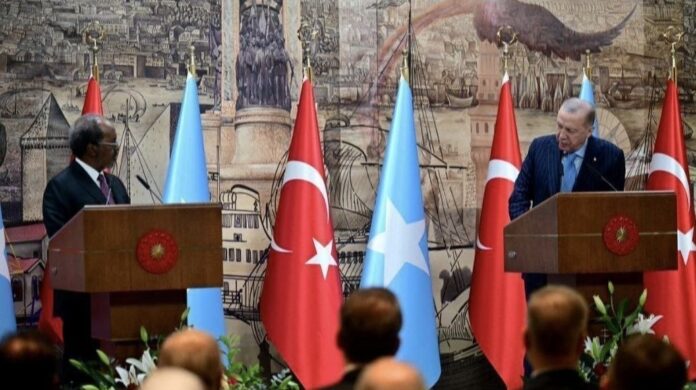
Somali President Hassan Sheikh Mohamud has announced that his country has awarded three of its 12 offshore hydrocarbon (oil and natural gas) exploration blocks to Türkiye. The President disclosed this during an extensive interview with Mogadishu-based media, praising the relationship with Türkiye as one of “concrete and sustained support.” While Western companies were initially given the opportunity to operate in the remaining nine oil exploration blocks, it was revealed that one Western firm recently returned its licenses, citing a lack of investment capacity.
When asked during the interview about the decision to grant the country’s critical oil exploration rights to Türkiye, President Hassan Sheikh Mohamud was remarkably blunt and direct. “Who else do we have besides Türkiye? Who else has come, wanted us, and supported us?” he asked. Through these remarks, the President emphasized that the bilateral relationship between the two nations is not merely built on diplomatic protocol, but rather stands on a demonstrated foundation of concrete commitment.
According to the President, Somalia had opened a total of 12 hydrocarbon blocks to international investors. Of those, three were awarded to Türkiye, while the remaining nine went to Western companies. However, a Western company that had taken seven oil exploration blocks recently returned its licenses to the Somali government, stating that it lacked sufficient financial and investment capacity.
President Mohamud further hinted that Türkiye could acquire additional oil blocks if it wishes. “Tomorrow, if they want, we can give them more than three blocks,” he noted, indicating that his country would gladly welcome Türkiye’s investment interest.
Hydrocarbon exploration off the coast of Somalia had long been interrupted due to decades of civil war and state collapse. Currently, however, as part of efforts to stabilize the nation and attract foreign capital, international attention has turned back to Somali waters. While Somalia’s Exclusive Economic Zone is estimated to hold significant, untapped oil and gas reserves, large-scale commercial extraction remains a longer-term prospect.
President Mohamud stated that Somalia’s external relations are governed by the principle of mutual benefit. He explained that various partnerships, whether with oil companies or foreign states, are evaluated based on the long-term benefits they bring to the country.
Elaborating on relations with the United States, he described the overall relationship as being in good standing, pointing out that occasional political tensions are tied to domestic political dynamics rather than fundamental disagreements. When questioned about Israel, he explicitly stated that Somalia’s current stance is grounded in political and humanitarian considerations, and establishing formal diplomatic ties is not on the agenda at this time.
The President acknowledged that the Somali government is simultaneously managing state-building, security operations, and economic development. He explained that these three processes move forward side-by-side and are interdependent.
Noting that the nation’s land, air, and naval security structures are being reorganized, Mohamud did not hide the fact that this effort is still in its early stages. While expressing gratitude to the international community for its years of sustained support, he reminded that building strong and durable institutions takes time. The fight against the al-Qaeda-linked militant group al-Shabaab, which controls vast territories in southern and central Somalia, remains ongoing, with the President identifying security improvements as the foundational pillar of state reconstruction.
Speaking on Somalia’s provisional constitution, which was adopted in 2012 and has served as the governing document through successive transitional administrations, the President described it as a “living document” that can adapt to the country’s evolving needs rather than being fixed and unamendable. He added that the ultimate responsibility for the constitutional amendment process rests with parliament.
The resident argued that many of the challenges facing Somalia—ranging from governance gaps to economic vulnerabilities—will resolve themselves as state capacity strengthens. “We want the world to come to us,” President Hassan Sheikh Mohamud said, signaling his firm desire to position Somalia as an open destination for international investment.