The Ta’sis (Sudan Founding Alliance) has issued a strong warning against any peace initiatives that exclude its participation, asserting that such efforts would amount to little more than a “public relations exercise” with no real prospect of resolving Sudan’s ongoing conflict.
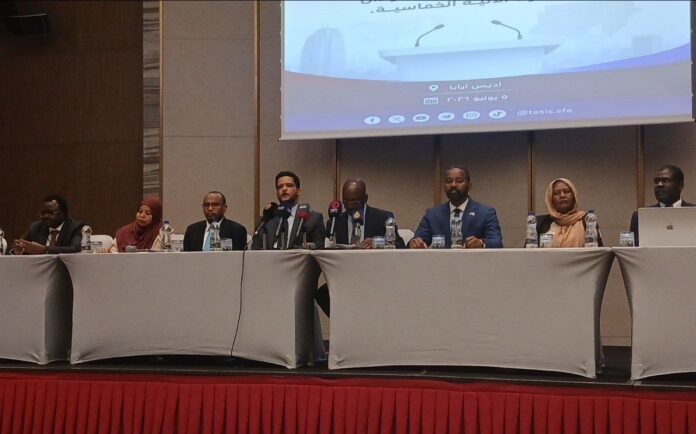
Speaking at a press conference in Addis Ababa ahead of a scheduled consultation forum with the five-party mechanism on Sudan, the alliance reaffirmed its firm rejection of any political or negotiation arrangements conducted outside established international frameworks.
The alliance’s spokesperson, Ahmed Tagad Lissan, dismissed reports alleging direct or indirect engagement with the Sudanese Armed Forces or what he described as the “de facto authority” in Port Sudan. He characterized the claims as baseless and reiterated the group’s commitment to internationally recognized peace processes.
A central pillar of the alliance’s position is the categorical exclusion of the Islamic Movement, the National Congress Party (NCP), and their affiliated political entities from any future political settlement. The group has aligned its engagement with the framework advanced by the Quartet on Sudan and called for an immediate three-month humanitarian truce under the Jeddah platform as a precursor to a permanent ceasefire.
According to the alliance, addressing Sudan’s worsening humanitarian crisis must take precedence over launching political dialogue. It argued that initiating negotiations without first stabilizing humanitarian conditions would be premature and ineffective.
On governance, the Ta’sis alliance defended the concept of forming a parallel administration but downplayed the importance of immediate international recognition. Instead, Lissan emphasized the alliance’s reliance on a broad network of diplomatic ties spanning regional and global actors.
The alliance also voiced concerns over what it described as a lack of neutrality within elements of the five-party mechanism. In particular, it criticized the African Union’s representative to Sudan, Mohamed Baalish. Despite this, the group maintained that the African Union remains the most suitable platform for facilitating Sudanese dialogue—provided that participating actors are selected based on objective criteria reflective of the conflict’s complexity.
Reinforcing the alliance’s position, leadership council member Mohamed Al-Mukhtar Al-Nour blamed the Islamist movement for prolonging the war. He argued that the Rapid Support Forces (RSF) did not initiate the conflict but were drawn into it following political developments after the October 2021 coup.
Al-Nour also underscored the alliance’s territorial influence, stating that Ta’sis controls significant areas across Sudan. He warned that any attempt to sideline the alliance would ignore the realities on the ground and risk imposing political solutions disconnected from the country’s actual balance of power.