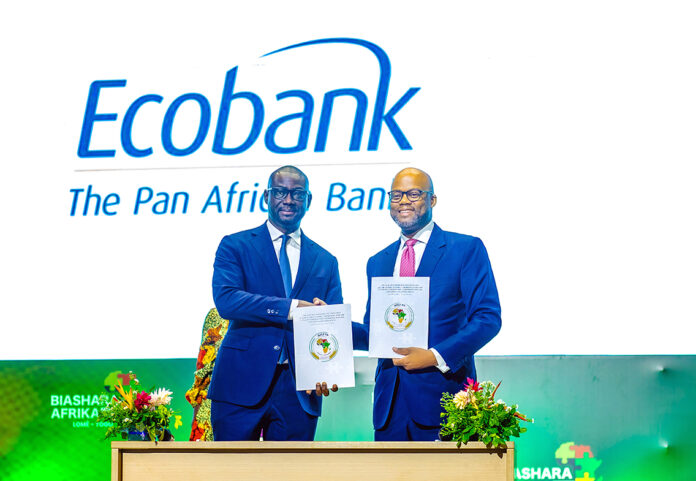
The African Continental Free Trade Area (AfCFTA) Secretariat and leading pan-African financial institution Ecobank Group have signed a historic Memorandum of Understanding (MoU) aimed at addressing the continent’s widening trade finance deficit. This landmark agreement is expected to open new economic pathways specifically tailored for Small and Medium Enterprises (SMEs), women-led business enterprises, and young entrepreneurs who have traditionally been locked out of conventional commercial bank loans and financing opportunities.
According to an official press release issued on Thursday, May 21, 2026 (Gimbot 13, 2018 EC), this partnership establishes a vital strategic framework to support the practical implementation of an integrated African single market encompassing over 1.3 billion consumers and a combined Gross Domestic Product (GDP) of approximately $3.4 trillion.
This newly established agreement builds directly upon Ecobank’s recent pledge made at the Africa-Forward Summit in Nairobi, where the pan-African lender unveiled a major $3 billion trade finance commitment to be deployed over the next three years. Ecobank committed to injecting this substantial capital into the continental market in close collaboration with various Development Finance Institutions (DFIs).
Under the terms of this new partnership, the AfCFTA Secretariat will play a critical role in ensuring that this multi-billion dollar fund effectively achieves its intended objectives by channeling capital directly to small-scale cross-border traders, female entrepreneurs, and youth start-ups that routinely fail to meet the rigid collateral and borrowing criteria of traditional financial systems.
Wamkele Mene, Secretary-General of the AfCFTA Secretariat, emphasized that affordable trade finance remains absolutely critical to unlocking the full economic potential of the AfCFTA, stating that this strategic alliance with Ecobank significantly strengthens the support systems necessary for African SMEs and women-led enterprises to actively participate in intra-African trade value chains.
To dismantle long-standing structural barriers across the continent, both institutions have agreed to align their efforts and focus aggressively on six core operational priority areas. First, they will prioritize SME capacity building by equipping small African enterprises with the networks, targeted training, and digital tools necessary to exploit burgeoning AfCFTA opportunities.
Second, the partnership aims to close the persistent gender financing gap by jointly promoting and expanding Ecobank’s flagship “Ellevate Program,” which provides tailored trade finance solutions to female entrepreneurs operating across both the formal and informal economic sectors. Third, the institutions will deploy Ecobank’s digital trade platform as a Single Market Trade Hub to systematically reduce information asymmetry among regional merchants and simplify trade matching. Fourth, they will foster direct business referrals by combining the official AfCFTA Trading Companies database with Ecobank’s sprawling commercial network to smoothly bridge the gap between continental buyers and sellers. Fifth, the alliance will engage in active policy advocacy with regulatory bodies to eliminate non-tariff trade barriers and mitigate cross-border payment friction. Finally, they will collaborate on thought leadership initiatives by co-curating high-level executive panels and regional business forums focusing on AfCFTA trade protocols.
This collaborative effort represents a major milestone for African economic integration, specifically leveraging Ecobank’s extensive operational footprint across 34 African markets to fulfill its foundational 40-year-old corporate vision of driving economic development and financial integration across Africa. Michael Larbie, Group Executive for Corporate and Investment Banking at Ecobank, noted that the institution’s unmatched cross-border presence and robust digital capabilities uniquely position it to act as an effective catalyst for the AfCFTA’s ultimate success.
While the AfCFTA agreement officially became operational in 2021, its overall continental implementation has been heavily hampered by persistent payment bottlenecks, regulatory mismatches, and severely restricted access to competitive capital for smaller market actors.
By combining the statutory mandate of the AfCFTA Secretariat with Ecobank’s massive $3 billion funding capacity, economic analysts view this alliance as a significant strategic step toward accelerating the African Union’s Agenda 2063 goals (“The Africa We Want”) and driving intra-African commerce. Although a detailed, phased rollout timeline for individual programs under the MoU was not immediately made public, both signatory parties confirmed that active implementation of the joint agreement begins immediately.