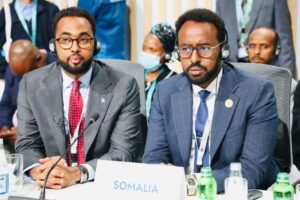
Somalia has intensified its efforts to rebuild the country following decades of conflict and recurring climate emergencies. Attending the 13th World Urban Forum (WUF13) in Baku, the capital of Azerbaijan, Somalia’s Minister of Public Works, Reconstruction and Housing, Ayub Ismail Yusuf, held a productive meeting on the margins of the forum with the Secretary-General of the Gulf Cooperation Council (GCC), Jassim Mohammed Al-Budaiwi.
This summit, organized by the United Nations Human Settlements Programme (UN-Habitat), has provided a major platform for Somalia to secure the international support and investment funds needed to rebuild urban areas and critical public facilities destroyed by war and natural disasters.
The discussions between the Minister and the GCC Secretary-General focused on urban reconstruction, infrastructure advancement, and sustainable investment programs. According to Somali officials, the talks specifically explored investment opportunities in housing, public services, and the rehabilitation of vital economic infrastructure. The Somali government believes that upgrading these infrastructures serves as the foundation for the nation’s long-term economic recovery strategy.
Earlier at the forum, Minister Ayub Ismail Yusuf outlined a comprehensive urban development strategy, highlighting projects focused on affordable housing and climate-resilient infrastructure in Beledweyne, Doolow, and the Jasiira area of Mogadishu. The minister emphasized that Somalia views its alliance with Gulf countries as strategically significant, particularly regarding infrastructure financing and economic progress.
Strengthening cooperation with Gulf governments, such as the United Arab Emirates (UAE), is seen as crucial to accelerating investment in key areas like renewable energy, education, healthcare, and maritime security.
This meeting clearly demonstrates the high level of attention Gulf states have been paying to the Horn of Africa in recent years by broadening their investments in ports, transportation, logistics, and energy ventures.
For instance, Oman has expressed its willingness to engage in technical cooperation and a structured investment framework for port development and logistics. Somalia’s South West State has reaffirmed its commitment to developing the strategic port of Barawe in partnership with a Kuwaiti company. Furthermore, Somalia and Saudi Arabia have signed a landmark maritime cooperation agreement focused on port development and Red Sea security.
For its part, Qatar has consistently supported Somalia in infrastructure development, humanitarian assistance, and security sector reform. In January 2026, the two countries formally signed a defense cooperation agreement to strengthen military ties and security collaboration. Building on recently signed security and maritime agreements, Saudi Arabia has also reaffirmed its firm position defending Somalia’s sovereignty, political independence, and territorial integrity.
Improved security in Mogadishu has boosted investor confidence, triggering a construction boom that includes residential and commercial projects, road rehabilitation, and drainage improvements. The Somali Ministry of Public Works is actively cooperating with UN-Habitat on urban planning and durable solutions for internally displaced persons (IDPs).
The World Urban Forum, established by the United Nations, is the premier international conference on urban issues. Held in Baku from May 17 to 22, 2026, the 13th session focused on inclusive, resilient, and people-centered approaches to urban development under the theme “Housing the World: Safe and Resilient Cities and Communities.”