
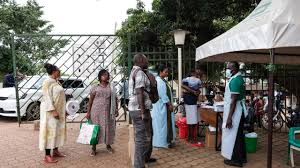
The World Health Organization (WHO) declared on Sunday that the ongoing Ebola outbreak in the Democratic Republic of the Congo (DRC) and neighboring Uganda is a “Public Health Emergency of International Concern” (PHEIC).
This emergency declaration was made at a time when it has been confirmed that the virus has rapidly expanded its geographical spread and entered Uganda’s heavily populated capital, Kampala. Health officials stated that the primary reason for this increased spread is due to travelers crossing the border into Uganda from the outbreak’s epicenter in eastern Congo. According to data released over the weekend by the Africa Centres for Disease Control and Prevention (Africa CDC) and the WHO, at least 336 people are suspected of having the virus, and 88 people have passed away.
The issue currently causing grave concern among international epidemiologists is the specific strain of Ebola responsible for the current spread, known as the “Bundibugyo” strain.
Although the Democratic Republic of the Congo and Uganda have experience managing more than 20 different Ebola outbreaks over the past few decades, this marks only the third time in history that the Bundibugyo strain has emerged.
The primary challenge is that, unlike the more common and well-known “Zaire” Ebola strain—which has been easily controlled in recent years using effective vaccines like “Ervebo”—there is currently no approved medication, specific treatment, or preventative vaccine for the Bundibugyo strain.
This strain was first identified during an outbreak in the Bundibugyo district of Uganda in 2007-2008, where it affected 149 people and claimed 37 lives. It re-emerged in 2012 in Isiro, Congo, infecting 57 people and causing 29 deaths.
Because the strain occurs so rarely, clinical research to find medical countermeasures has lagged behind; consequently, the medical care currently provided by healthcare workers is limited only to supportive treatment, such as maintaining hydration levels in the body and managing secondary infections.
Presently, the majority of Ebola patients are located in Ituri, a security-compromised eastern province of the DRC that borders Uganda and South Sudan. However, the reality of the virus crossing borders through human movement has now transformed the outbreak from a local threat into a regional emergency.
Uganda has confirmed that the virus entered its capital, Kampala, via two separate individuals coming from the Democratic Republic of the Congo. The first traveler, who originated from Congo, became critically ill and passed away in a Kampala hospital.
Shortly after the death of the first traveler, a second infected individual was detected in the city. The WHO pointed out that the two patients had no contact with one another, which significantly heightens the concern.
This indicates that the virus is entering Uganda from the eastern provinces of Congo through different routes and independently. The occurrence of Ebola in a major city like Kampala, which is home to nearly 1.5 million people, creates an immense challenge for health professionals conducting contact tracing.
The potential for the virus to spread rapidly in densely populated urban centers is far greater than its transmission in rural areas. Despite the declaration of an international health emergency, WHO Director-General Tedros Adhanom Ghebreyesus and other health officials urged the international community to view the situation calmly and avoid unnecessary panic.
In an official statement released on its social media page X, the WHO explicitly noted that the current Ebola outbreak does not meet the criteria for a global pandemic like the COVID-19 pandemic. Furthermore, the WHO strongly advised against imposing international travel or trade restrictions, as closing borders drives trade into illegal channels, harms the local economy, and hinders the movement of essential medical personnel and equipment.
Instead, the international community’s focus will be directed toward key interventions. These include strict contact tracing to isolate everyone who has been in contact with infected individuals in Kampala and Ituri, community engagement to educate locals on safe burial practices and early recognition of symptoms, and cross-border cooperation to strengthen health screenings at official border checkpoints between Congo, Uganda, and South Sudan.