
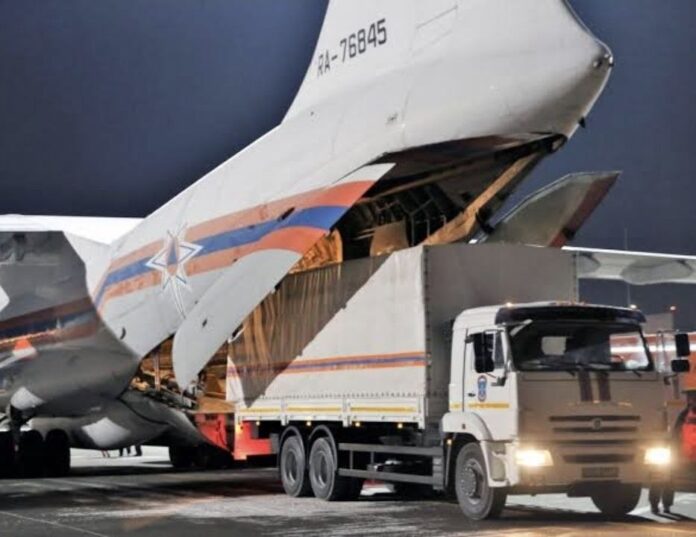
At a time when the humanitarian crisis in the Horn of Africa is severely worsening, Somalia has officially received 25 tons of emergency food aid sent from the Russian Federation. This critical shipment arrived at a crucial moment when the country has plunged back into deep crisis due to severe drought, recurring localized conflicts, and a reduction in international humanitarian funding.
The official handover ceremony took place in the capital city, Mogadishu. The ceremony was attended by high-ranking officials, including Somalia’s Minister of Communication, Abdifatah Kasim Mohamud, the Chairman of the Somali Disaster Management Agency (SoDMA), Mohamud Moallin Abdulle, and the Russian Ambassador to Somalia and Djibouti.
During the ceremony, Communication Minister Mohamud stated that this support arrived at a very critical time for thousands of vulnerable families displaced by current emergencies. Agency Chairman Abdulle expressed his gratitude for the aid, noting that this provision would further strengthen the diplomatic and humanitarian relations between the two countries. Abdulle added that this is not the first time Russia has provided such assistance to Somalia, and that the Russian government and people have practically demonstrated their friendship and support for the Somali people.
The arrival of this Russian aid highlights the grim reality in the country. International food security monitors have issued urgent warnings that some areas in southern Somalia could face the threat of famine. According to new Integrated Food Security Phase Classification (IPC) data, the Burhakaba district in the Bay region has reached official severe acute malnutrition level 5 (IPC Phase 5). This level is classified as “catastrophic,” indicating that the area is inevitably prone to famine if conditions continue to deteriorate and urgent intervention is not made.
Somalia’s vulnerability to food insecurity is linked to consecutive natural disasters and ongoing instability. The country experienced a devastating famine in 2011 that claimed the lives of approximately 250,000 people, and faced similar threats during severe droughts in 2017 and 2022.
Humanitarian organizations have stated that responding to the current crisis has become uniquely challenging due to global geopolitical shifts. Aid groups are currently facing major hurdles, including reduced funding, as significant cuts in international aid have severely depleted the operational budgets of non-governmental organizations (NGOs) on the ground.
Additionally, rising supply costs driven by inflation and global conflicts have increased the expense of importing and distributing therapeutic foods. Consequently, malnutrition is escalating, with IPC estimates showing that nearly 1.88 million Somali children will require urgent treatment for acute malnutrition over the course of 2026.
Russia has delivered 25 tons of food aid to Somalia
Previous article
Next article